A Banner Day
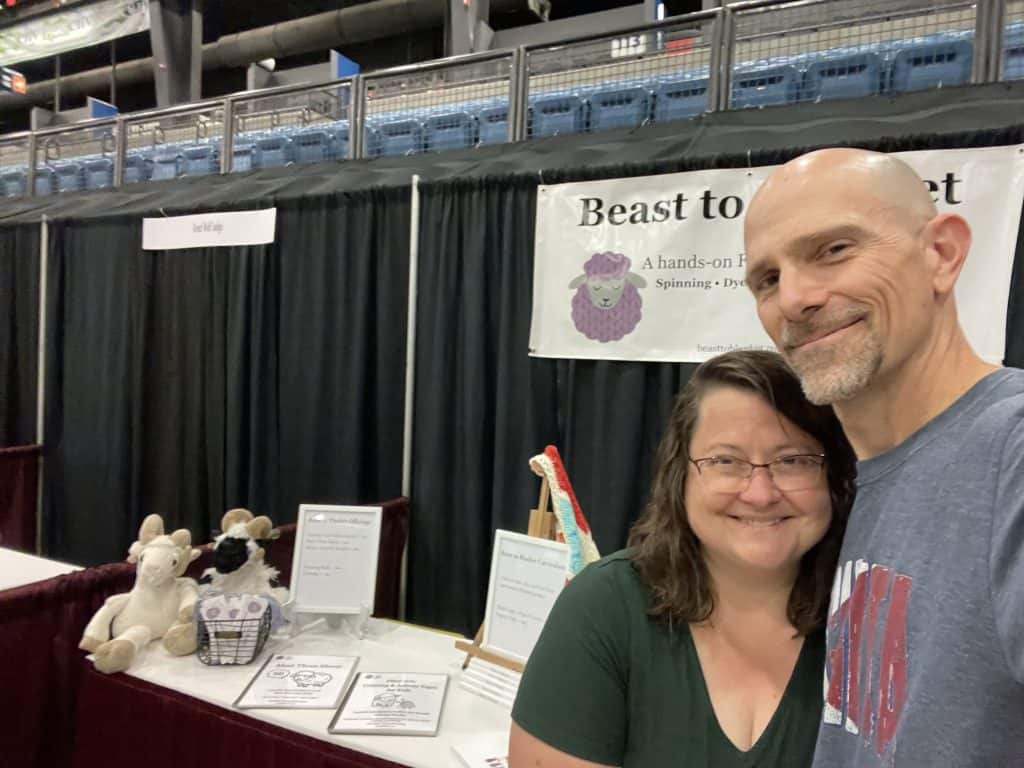
By the time this travels through the internet, Greg and I will have completed our first day ever at a home school convention, representing Beast to Blanket and Pemberley Woolworks.
As I’m writing this today, I’m looking at boxes of supplies and products ready to be staged and packed to travel the short distance to Wichita for our first experience of sharing these with home educators.
I don’t talk about these a whole lot in my newsletters. I tend to feel a little itchy when I veer into salesy talk. (This weekend is going to be a stretch for me!) But I thought I’d just briefly share the overview so those of you who are newer can see a glimpse of this side of what we’re doing.
The big project has been the Beast to Blanket Curriculum Guide, based off of a class I taught to my homeschool cooperative when my kids were young, and afterwards when requested. I was so encouraged by the responses to the classes by both students and parents that I wanted to make those experiences possible for anyone.
That led to providing some introductory lessons for younger students who might not yet be ready to dive into Beast to Blanket. We’re making printed Meet Three Sheep and Fiber Arts Coloring & Activity Pages available at the conventions we attend this Spring.
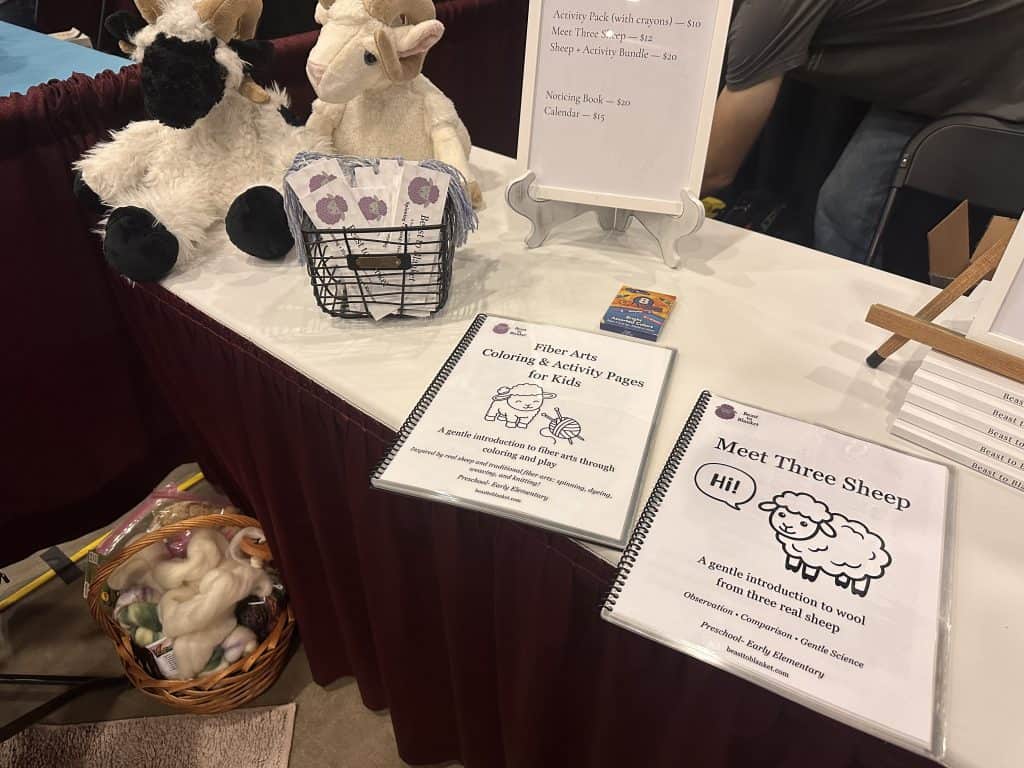
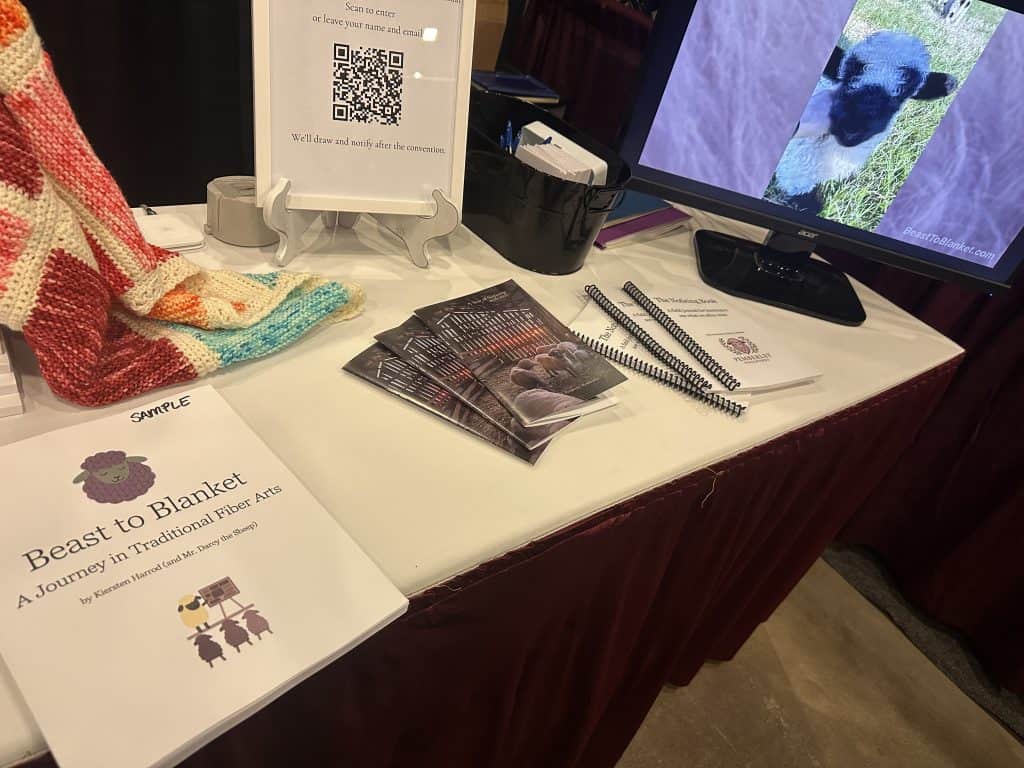
Most recently, we’ve been developing materials aligned with how we’re working to slow down and observe what is happening around us at the farm. We’re learning these are foundational skills for observing, listening, and learning at an unhurried pace. We created The Noticing Book and A Year of Noticing calendar that we’ll be introducing at these conventions. I’m looking forward to sharing more about those later.
It’s an exciting time for us, as it pulls together all the threads of Pemberley Woolworks, from the sheep to the knitting, from the laptop in the office to the paddock at sunset. I’m so grateful for the opportunity to share it with others.
My hope is that those who would benefit most from Pemberley will find us.
If you happen to be there, please do come by and say hello! I’ll be the awkward short lady working the spinning wheel.
Greg’s Got Questions
Thank you to all who voted on the questions last week! Once again, we had a tie. Last week’s winning questions were:
What’s the significance or story behind Martin’s name? and What’s the story with the live chicken prop?
First, Martin.
Robert Martin is a minor character in Jane Austen’s book Emma.
Emma takes a young, impressionable woman from a lower class under her wing and determines to “improve her.” Part of her meddling includes persuading this young woman, Harriet (yes, that’s where our Merino lamb got her name), that she should refuse Robert Martin’s proposal of marriage. The reason Emma gives is that a lowly farmer is not “high enough” for someone she has singled out to be her particular friend.
Robert Martin is a worthy, honest, hard-working farmer whose character is esteemed by Mr. Knightley, the hero and moral compass in Emma’s life. When Emma and Harriet come to their collective senses at the end of the novel, Harriet gratefully accepts Mr. Martin’s gracious offer.
Our Martin is destined to be a wether in our flock. He won’t make other sheep but be a buffer and a buddy to sheep who need to be isolated for one reason or another. For example, when the rest of the ewes go into the rams’ pens for breeding, Martin (and Fitz, our other wether) will stay with the ewes who are not selected to breed. Or, when a ewe might need to be separated shortly before lambing, Martin might accompany her, so she still has a buddy sheep and isn’t stressed by being alone.
He’ll be a humble, working sheep, fulfilling an important role outside of the spotlight. Martin seemed like a good name for a Babydoll wether.
About the chicken prop...
We got a new drama teacher my senior year of high school. He had really big ideas.
For the Spring Play, he chose Firefox. I can’t remember the author. I can’t remember much of the story other than it took place in Appalachia, there were six of us in the cast, and I played a teacher who apparently kept chickens.
Oh, and all the action took place at the main couple’s house, so we sort of built a house on the stage, and this new drama teacher hauled in a truckload of actual dirt and had it dumped on the stage. For realism. I have a strong feeling this was one of those “ask forgiveness instead of permission” deals.
That might have also been the case with the chicken.
Anyway, every time my minor character came over to the house, I carried a live chicken. Its name was Gudger. Really.
The best part? I, who had never had previous contact with a chicken not wrapped in clear plastic, was given the following instructions:
IF IT STARTS ACTING FEISTY, JUST FLIP IT UPSIDE DOWN AND HOLD IT BY ITS LEGS. IT’LL PASS OUT AND CALM DOWN.
Sweet honey mustard.
I did it, too. And they were right.
Please don’t tell PETA.
Questions for This Week
(As a matter of procedure, the poll function takes you to another page to submit your vote, so if that happens to you, you’re on the right track!)
Question 1: Why do you think Martin’s wool looked like a hand-dyed Easter egg when he finally exited Lucy?
Question 2: What sort of purpose do you have in mind for young Master Martin on Pemberley Farm once he’s matured?
Question 3: And, of course, the question I have to ask every time a new name arrives in our Jane Austen-esque world, why “Martin?”
Question 4: Would you be willing to share more about the live chicken prop high school experience? Was there only one chicken involved? Did he or she have a backup? What play involved live animals? Were any eggs produced during rehearsals? Did the Kansas State chicken department provide this bird? So many questions…
Happy knitting,
Kiersten J