
Food Security
I don’t know about you, but it’s starting to feel a little dangerous to go to the grocery store to me.
Now eggs.
I even saw a shocking recall announcement about a coffee product in New York and New Jersey the other day. Talk about a nightmare.
It makes the rebellious teenager corner of my heart think that hyper processed food might not be the worst thing I could eat at the moment. Then the mid-fifties reality-based body points out that the rebellious teenager is in the corner for a reason.
Producing food is not easy.
We’ve been enjoying Clarkson’s Farm the last several weeks. Amid all the hilarity, the relatable goof ups, and the interesting level of profanity that is part of everyday speech in their world, the show does a remarkable job of demonstrating how very difficult it is for farmers and ranchers to make a living. In actuality, I think their point is that it is becoming more and more difficult for folks to stay in the farming business at all.
It’s eye-opening, for certain. I often think about how much I have to learn when it comes to taking care of our little flock of sheep, and how I might creatively find ways to make this adventure self-sustaining. But for the families whose farms are their livelihoods, the stakes are much higher.
In addition to continually educating themselves on better ways to care for their animals and land, they must also constantly adjust to changing markets and legal requirements. It’s a lot, and it seems to make every crop and every season a gamble.
I’m learning a deeper gratitude toward the people who grow and raise our food. If you’re one of them, thank you. Sincerely.
My mother-in-law asked if I’d seen the story about the recall of the eggs. She asked me this during our daily discussion of how our girls had done that day in the egg-laying department.
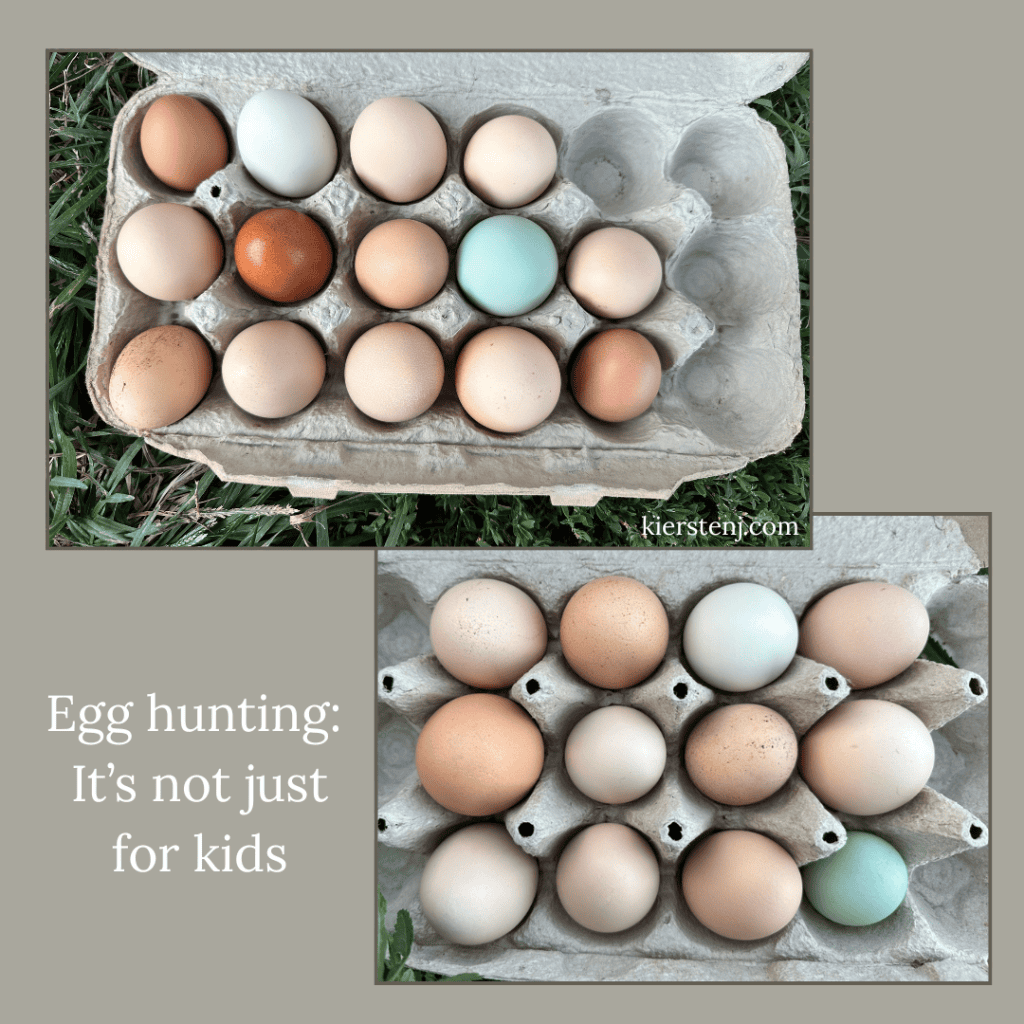
We’re in a fun season now with these girls. The old guard is continuing to be productive while last March’s recruits are starting to join the laying ranks. I think we’ve got about eight of the twelve newer girls laying now.
But there’s a hitch. The youngsters simply refuse to use their nesting boxes. The eight of them are using at least five locations.
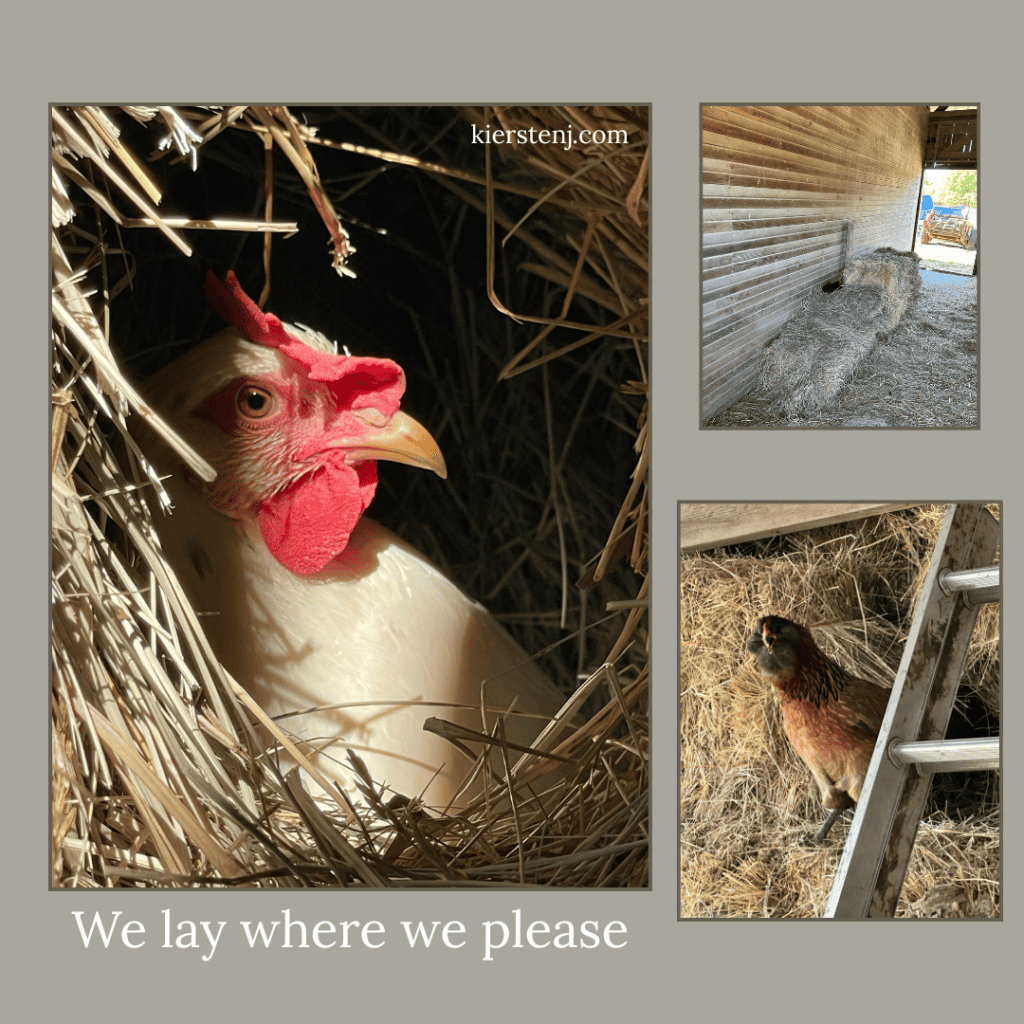
You might remember from an earlier letter that the first new girls to lay decided to use a hole in the hay pile in the barn, now referred to as the Hay Cave. Over the last couple of weeks, two more hens have deemed this location acceptable.
One hen periodically lays in the scrap wood pile in another section of the barn. An upturned bucket in the far recesses of the barn has also been recognized as an acceptable receptacle. As has an increasingly deteriorating indention between two bales of hay in the barn hallway near the sheep stalls.
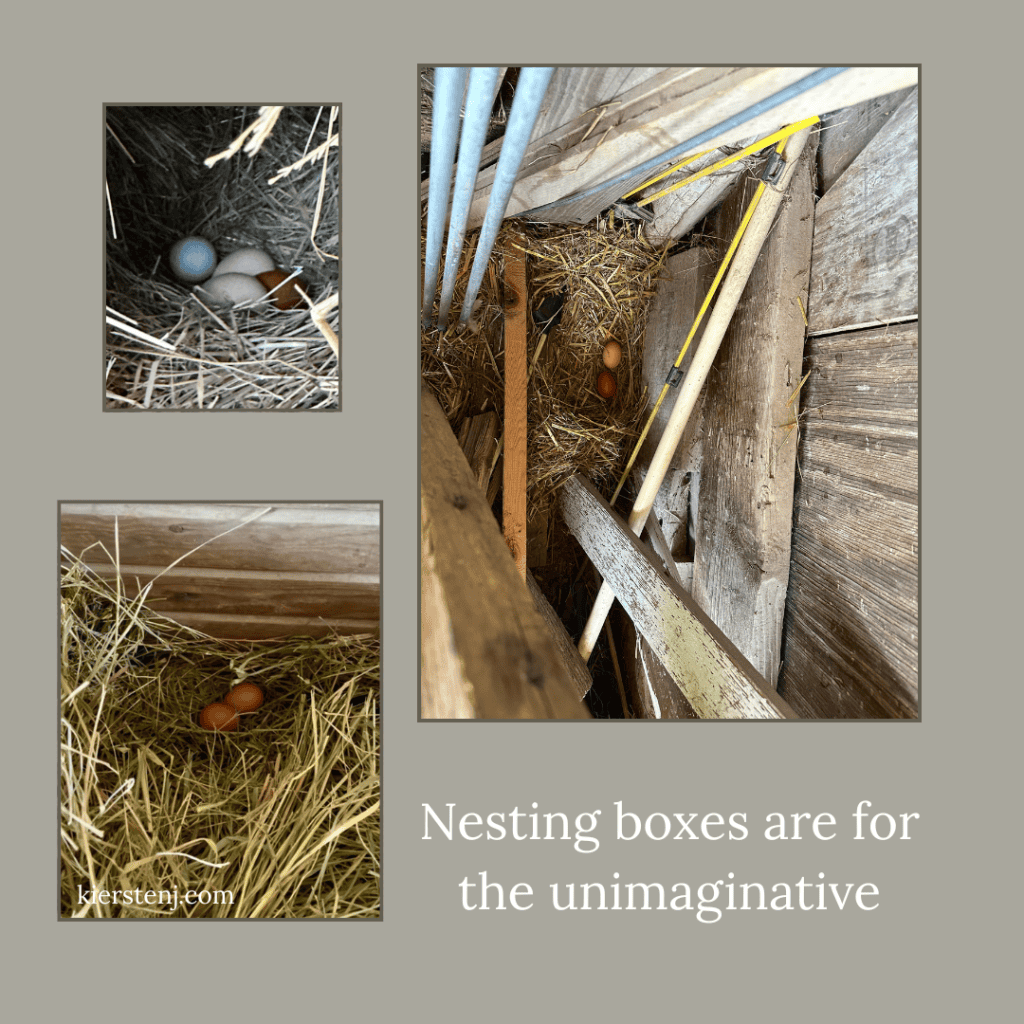
And get this: At least one of the March girls has been sneaking into the older hens’ chicken house to make use of THEIR nesting boxes. Like she doesn’t have five pristine nesting boxes in her own house. I don’t get it.
In any case, egg-gathering is a highlight of my day. I love seeing where they appear and trying to figure out exactly who is laying where.
What I didn’t love was arriving at the barn to an obvious crime scene. Feathers everywhere. White feathers in the yard, black feathers in the barn hallway, and the only visible chickens were tucked up tight into hiding places.
We’ve been using live traps in the last several weeks to catch possums, skunks, and many, many raccoons that might harass chickens and steal eggs. This looked different. After some feather tracking, head counting, and some amateur CSI crime scene reconstructing, we think we may have had a coyote visit.
A bunch of free-ranging chickens are a tempting sight, and we’re guessing Mr. Wyle. E. Coyote started chasing a black-feathered chicken into the barn, missed grabbing her, and then was successful with a white and brown hen.
I know this is part of keeping chickens. Especially if we want to let them free-range. It’s not unlike knowing sheep carry parasites and may sometimes get overloaded and fight anemia. There are costs and losses and unpleasant surprises.
I imagine the lettuce farmers and layer farms and distributors dealing with all the recalls know this feeling on a much larger scale.
The more I learn about raising animals, the harder it is to look at any finished product the same way again.
One of the reasons I love teaching the Beast to Blanket class is helping students see the entire process of wool production, starting with the sheep. Appreciating the beginning, and all it takes to make sure that beginning can actually happen, changes how we value the end product.
This week I’m feeling that lesson sink in more deeply about our food. I’m looking at the contents of my fridge a little differently, thinking of who and what it takes to produce it and get it to my kitchen.
Even chickens who refuse to use perfectly good nesting boxes.
Greg’s Got Questions
Thank you to those of you who participated in the last poll!
The winning question was: What benefits do mulberry leaves and branches have for the sheep?
Mulberry leaves and branches are considered “browse,” which are part of what makes a good sheep diet. Sheep out on a pasture don’t just eat grass, but other forms of forage. Here’s a great site that goes into more detail about different kinds of forage livestock eat.
One of the major benefits of mulberry is the protein content. The feed we typically give the sheep is 15-16% protein. This study found the protein content of mulberry branches to range from 15-28% crude protein, which is at least as good as the feed, if not better. For growing lambs, gestating ewes, and wool producers, protein is important. There are other trace minerals that are good for them, too, and because it’s easy for them to digest, all that goodness is readily available for their sheepy systems.
Also, the sheep love it. They go nutso when they see it coming, and it feels like we’re giving them a treat.
This Week’s Questions
(As a matter of procedure, the poll function takes you to another page to submit your vote, so if that happens to you, you’re on the right track!)
Question 1: How mad would you be if you were to find out that your husband is now tempted to start relocating eggs while you’re not at the barn?
Question 2: Have you researched crossbreeding our hens with a roadrunner? I wonder what sound that creature would make. And do you have the contact information for Acme? I think I’m going to need an anvil or two and some TNT and maybe a few of those stick-anywhere holes.
Question 3: What learning from Clarkson’s Farm has been most helpful or applicable to what we’re doing at Pemberley Farm?
Question 4: What aspect of nesting boxes do chickens typically find attractive? In other words, why don’t all chickens just deposit their eggs in seemingly random places like ours do?
Happy knitting,
Kiersten J