Place
Why THERE?
I was standing quietly in the corner of the chicken coop, as one does on a pretty midmorning. I was hoping for a repeat of the performance I’d happened upon the other day, and it looked like the first act was about to begin.
You see, the chicks we got last October have started to lay their eggs. We got six Australorps and three Golden Laced Wyandotte chicks (all allegedly pullets, more on that in a minute) from the local farm supply store. This is my first experience watching the whole cycle from chick to laying hen, and it’s been completely fascinating to me from their first pin feathers to their introduction to the older hens, and now to Their Big Moment: Graduation to Laying Hen Status.
Those of you who are familiar with chicken life already know this, but I didn’t: the first eggs are mini size. You know those tiny sized candy bars they sell around Halloween that feel like a little bit of a cheat because they’re not even a whole mouthful? These eggs remind me of those, but instead of feeling cheated, I feel like we discovered something rare. I wouldn’t be surprised if some chicken lovers found ways to preserve these. “Eggatha Christie’s First Egg” in a shadowbox or something.
Etsy should get right on that.
Anyway, we’re finding most of these pullet eggs in one particular corner of the chicken coop. On the floor. There are ten perfectly good nesting boxes in this coop. But for some reason that only makes sense using chicken logic, that corner is The Place.
I acknowledge that I am not a chicken, at least in the biological sense. But you know what? Of all the corners in that coop (and there are four of them), I think it’s the worst one for egg placement. It’s right by the door the chickens use to go in and out of the coop. It’s as far as you can get from the nesting boxes and still be inside the coop. It’s directly under the prime nighttime roosting spot, so the chances of unpleasant rain are good. It’s on the floor, for Pete’s sake.
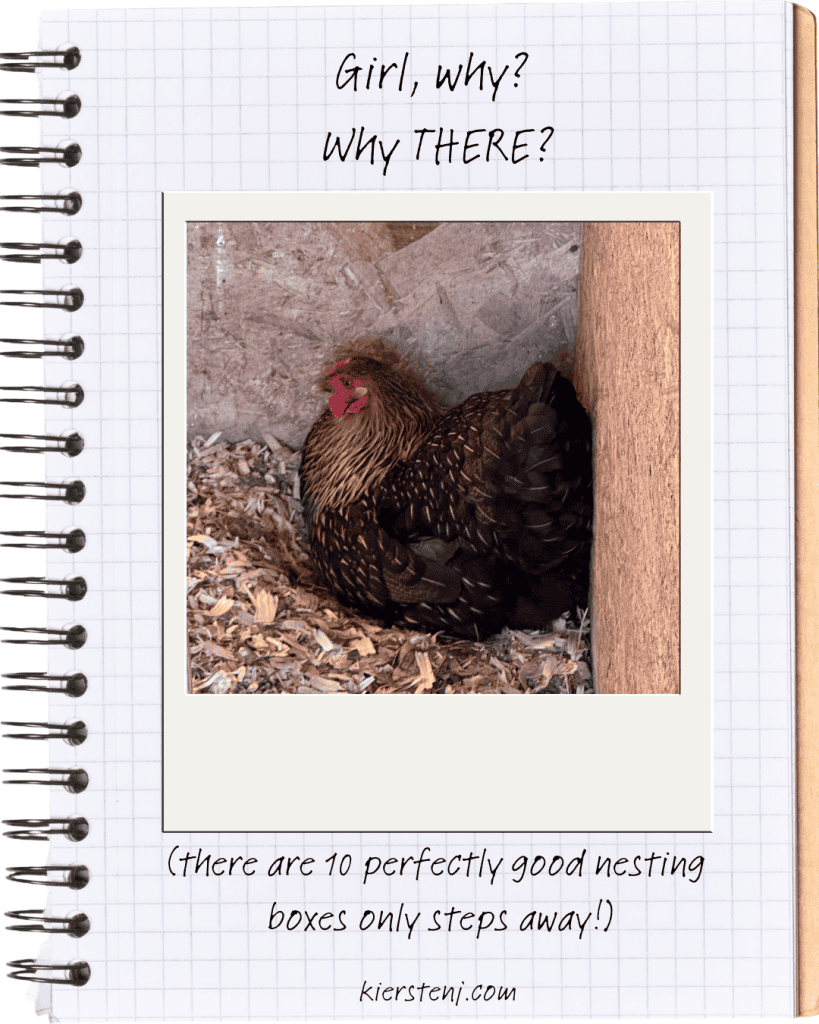
And the worst aspect of that spot is that it’s much less protected than a nesting box, so a potential layer is at the mercy of all the other chickens who feel free–no, OBLIGATED to comment, kibitz, criticize, poke, peck, and perturb any poor pullet who might place herself in the corner with the idea of having a quiet moment to lay.
And so, my question: Why THERE?
I thought a similar question with the not-a-pullet Australorp chick, Rooster Cogburn, who became a free-range rooster last week.
Elvis, the established rooster who has Godzilla energy constrained in the body of a bantam, does not care for Cogburn. Cogburn, who could probably swallow Elvis in a gulp and a half, was terrified of Elvis and was sporting bare patches on his neck from being strongly and repeatedly encouraged to remember who Chief Roo of the coop was.
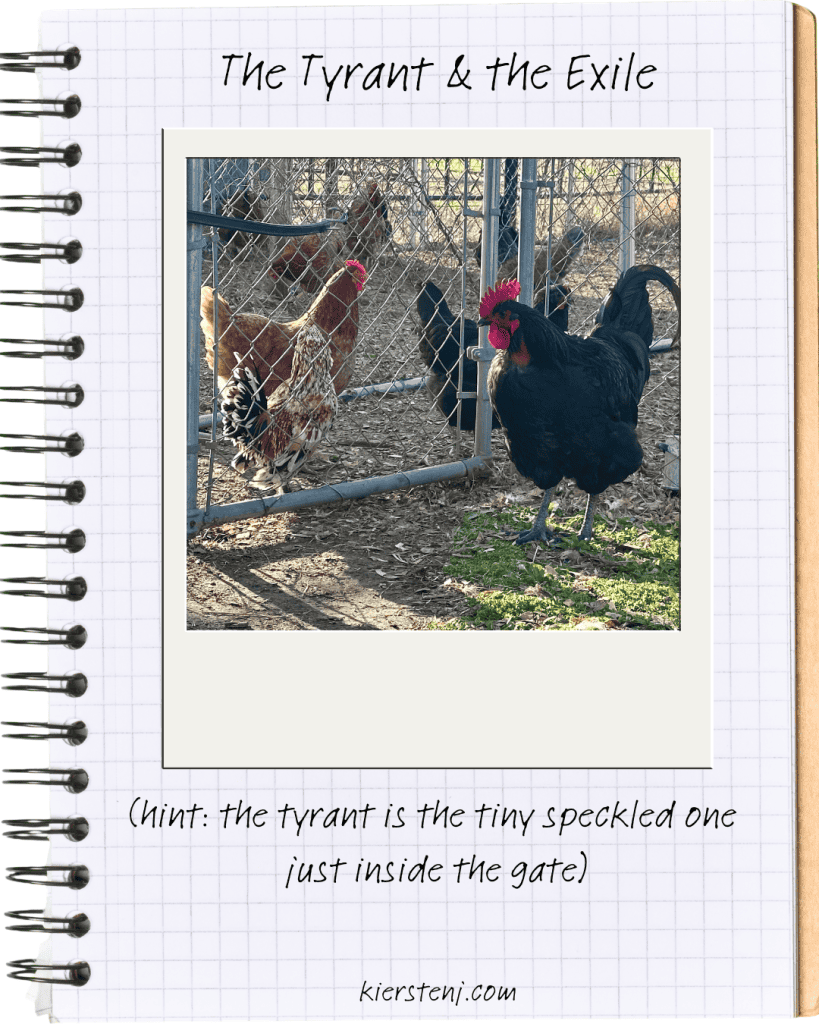
We decided that even if the rest of Cogburn’s life was short, it would be an improvement to be less terrorized, and so we released him from the confines of the coop and fenced run. After a few maneuvers around the barnyard, he took off across the road and into a ditch. We lost sight of him for a while. Later, we came back to find him, still across the road, but perched on top of a round hay bale. He had a whole barn, a couple of other sheltered structures, and the entire familiar yard he could have picked, but he went across the road.
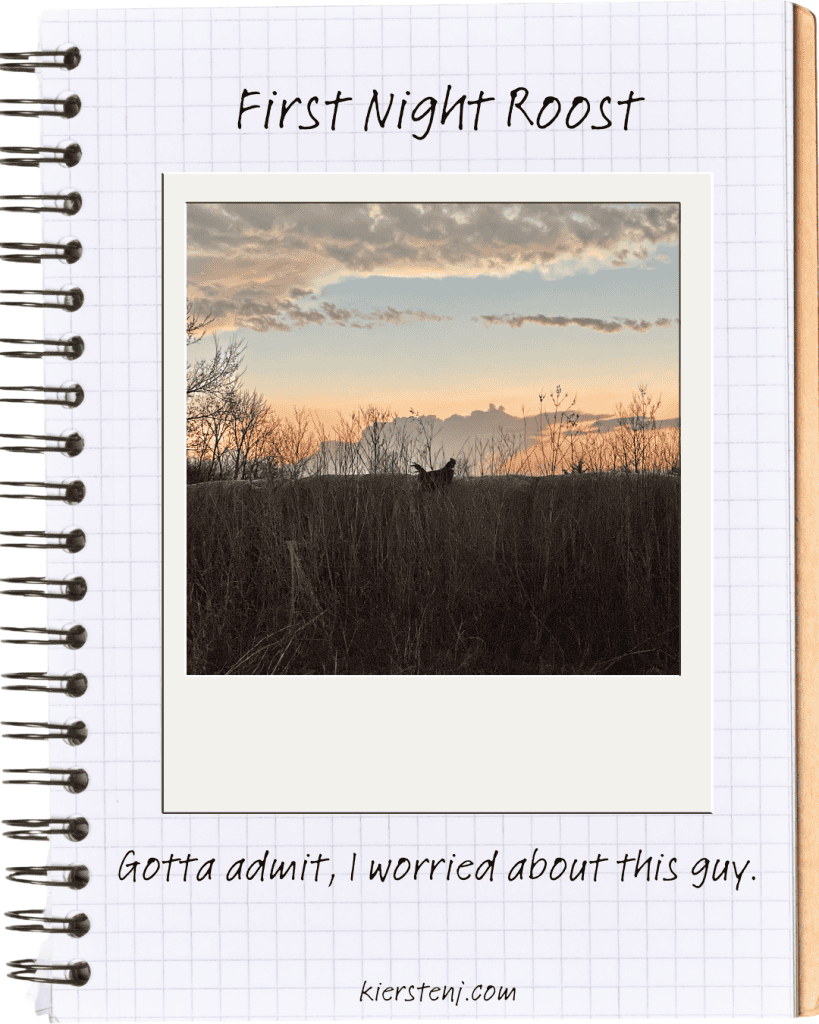
The next day he got himself back across the street, but “stuck” in a big paddock.
He’s now back in the yard, patrolling, centered around the coop and run, but slowly expanding his territory. His current nighttime roost is an old tractor in the barn, but I’m not sure he’s settled on exactly where his place is yet.
My favorite part of the day is when all but the last chores are done, and we let the ewes into the big stall where their feed is waiting. There’s a big rush, because they love the stuff, and then they settle into the serious business of getting as much hay as possible into their bellies. There are three hay feeders in the stall, and it’s fascinating to watch the movements between them.
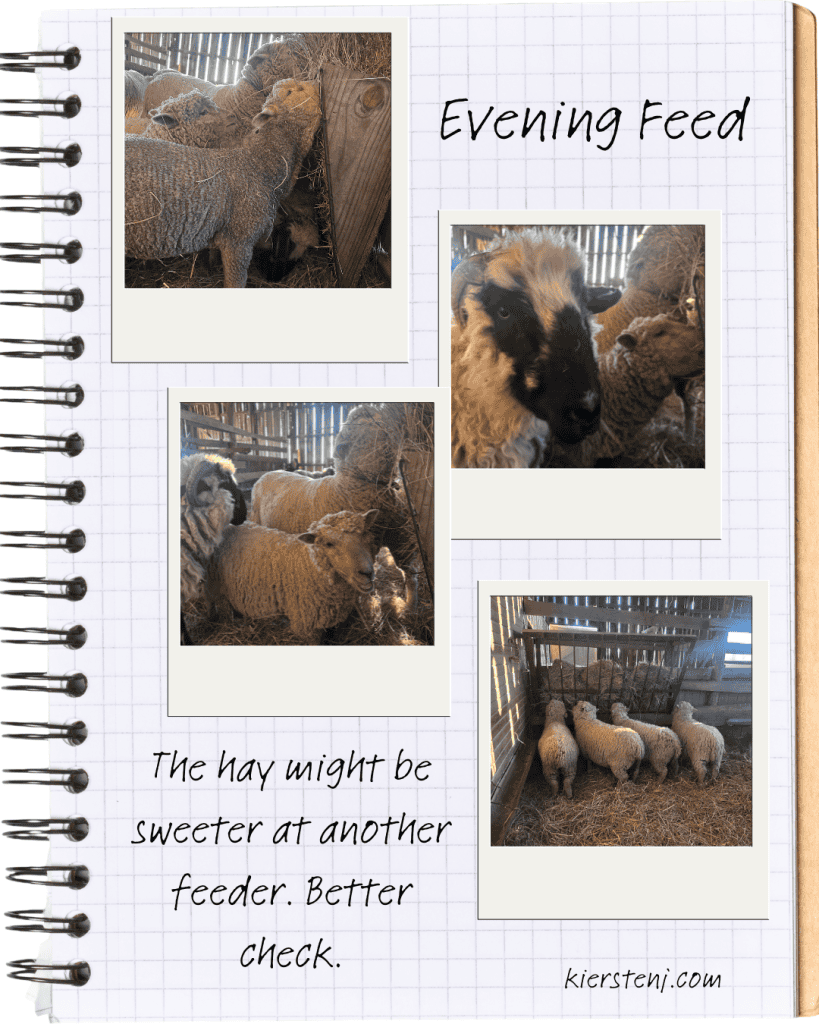
Some of the ewes like to stay at the same feeder most of the time. Some make circuits that can appear methodical. Some seem completely random.
And sometimes, something will startle them all, there will be a massive reshuffle, then they’ll settle, but never in exactly the same arrangement.
I’m noticing something similar in me as we’re doing our own reshuffle. As we sort through belongings, pack boxes, bring some things, say goodbye to others, find places for stuff in our new space, and create spaces for what is new, we’re settling in, but the arrangement is necessarily different.
It’s not just about downsizing a house or going from urban to rural, though that’s certainly part of it. The choices we’re making about what we’re prioritizing do more than determine the location where the next chapter takes place. They also shape the character of the life that will be in that place.
It’s nothing earth-shattering. It’s not dramatic.
It is more a matter of being aware of how these transitions are gifts. They’re organic opportunities in normal life to intentionally “settle” in a slightly different place than the one we came from.
Greg’s Got Questions
Thank you to those of you who participated in the poll last week!
The winning question was: Of your 17 moves, which was the most extreme for you? I’m thinking about the move that was the furthest distance, biggest upsize or downsize, most joyous, scariest, etc.?
I was in my early twenties, with one young child, and we moved from Kansas to a suburb of Jackson, Mississippi.
It is important to note that I had lived in Kansas since I was four, and my exposure to all things Southern was through books, movies, TV, etc.
It is even more important to note that I am VERY grateful for my time living in the South, in several different locations. I met some wonderful, lovely people and got to experience and learn amazing things.
That being said, moving there was a complete culture shock for me.
One of the first things we did after arriving was go to the grocery store. The local grocery store was called (I am not making this up) Jitney Jungle. What. On. Earth.
Graduate school is not a time when most folks are flush with cash and we were no different, so I tried to stock up on inexpensive staples. At that time, in Kansas, you could get hamburger on sale for less than $1/pound. (No, I’m not playing Two Truths and a Lie.) It was much more expensive at the Jitney Jungle. So was tuna. So was a lot of stuff. I am pretty sure I cried.
That seems like a complete overreaction, and maybe it was, but it might seem slightly more understandable if I tell you that right before we left for the grocery store, I took a phone call. (On the house phone. Really.)
I am 85% sure that the nice lady on the phone was trying to sell me a subscription to the Jackson newspaper. I can’t be 100% sure, because I could not understand her. Absolutely could not. Her accent was AMAZING. And I was from Kansas. And I have never, before or since, had as much trouble understanding another human being on the phone as I did this woman.
Bless her heart. And I don’t mean in that special way that I learned you could say that phrase while I lived in Jackson. I mean it in the genuine, “Lord, please bless this woman, because I just made her day hard” kind of way. After about three repeats of her message, I finally said something like, “This is no fault of yours, but I cannot understand what you’re saying, and so I’m going to hang up the phone now. I’m really sorry. Bye.”
She probably thought they’d let someone answer the phone who shouldn’t have been allowed to have contact with the outside world.
Then I went to the Jitney Jungle of all places and couldn’t find tuna fish and couldn’t buy ground beef without taking out a loan.
Hence the tears.
Greg’s Questions for This Week:
Here are the questions up for the vote this week. I’ll answer the winner in the next newsletter. (As a matter of procedure, the poll function takes you to another page to submit your vote, so if that happens to you, you’re on the right track!)
Question 1: Regarding Cogburn’s trip across the road, of course I can’t not ask, on behalf everyone who is also thinking it, Why?
Question 2: How does your wondering about the reasoning for why our farm critters do certain things in their chosen locations apply to knitting? Do you have similar “Why THERE?” questions about knitted creations when you’re observing them?
Question 3: Would you care to explain the origin of the roosters’ names, Elvis and Cogburn, for your readers who might be curious?
Happy knitting,
Kiersten J