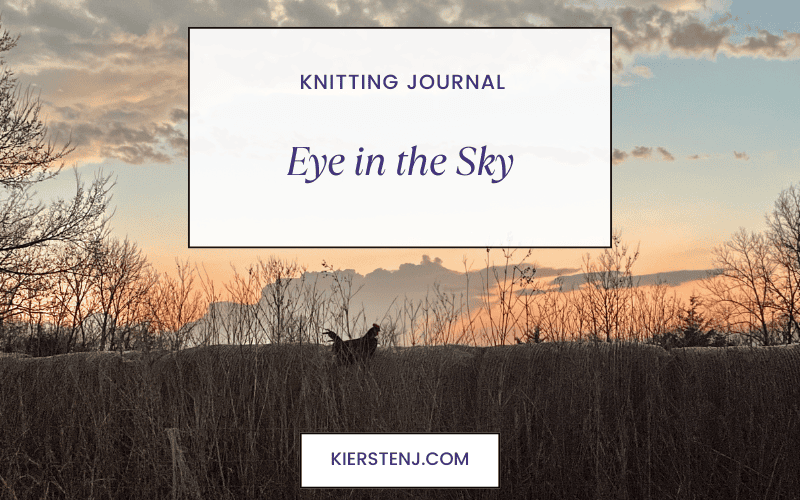
Eye in the Sky
I could justly be accused of being a Helicopter Shepherd.
I’m not sure that’s an actual term. I’m morphing it from a title lovingly given to me by one of my siblings years ago. I was thoughtfully and generously flooding this sibling’s phone with texts of daily photos of garden plants I was attempting to not kill.
I was convinced they would be as fascinated with every millimeter of growth and possible evidence of health as I was. I don’t think the patient reception of the photos and kind encouragement ever stopped, but I do know that “Helicopter Gardener” came out of those exchanges.
Oh, friends. I have upped my game since then.
Thanks to Greg’s problem-solving skills, willingness to scale heights, and kind-hearted nature to do his darndest to make my weird ideas work, I can helicopter shepherd from the comfort of my air-conditioned home. And I do.
It turns out that two inexpensive security cameras stuck on the rafters of the barn work out amazingly well as the official Pemberley Farm Barn Cams. Greg got this all set up during lambing season, saving us several “just checking” trips to the barn during the middle of the night.
Lambing season is finished for 2026, but I’m finding the Barn Cams extremely helpful as I Helicopter Shepherd the last portion of weaning season.
If you take a moment to think about it, weaning is a really weird time for sheep. With the exception of our rams, who are housed a small distance away from the ewes and lambs, every sheep is affected by this social and biological upheaval.
Before removing the Three Amigos from the big ewe group, there were three ewe/lamb pairs as part of that flock’s social registry. Moms had at least part of their focus on their lambs and honorary aunties had to do their part to teach little upstarts to mind their elders. Lambs’ priorities were first to keep track of mom, second to see if milk could be acquired from other sources (I’m looking at you, Lucas), and third to test their elders’ patience.
Taking the boys out of that equation had several interesting effects.
While the lambs were hollering, Maryanne and Louisa spent about a day looking like they were trying to figure out which other ewe had babysitting duties that day. Lucy spent the day nose deep in grass in a temporary state of profound hearing loss.
At evening feed, the adults all enjoyed a little extra space around the hay and feed and a little less energy inside the stall. Lucy appeared to finally notice the absence of her sidekick. She called, heard his response (muffled due to his mouth being full of feed), and carried on.
Meanwhile, in the smaller flock that (for want of a better term) I’ve been referring to as the Hooligans, the Three Amigos appeared to have merged into one being. Martin, Frederick, and Lucas might as well have been velcroed together as they first navigated their new social sphere.
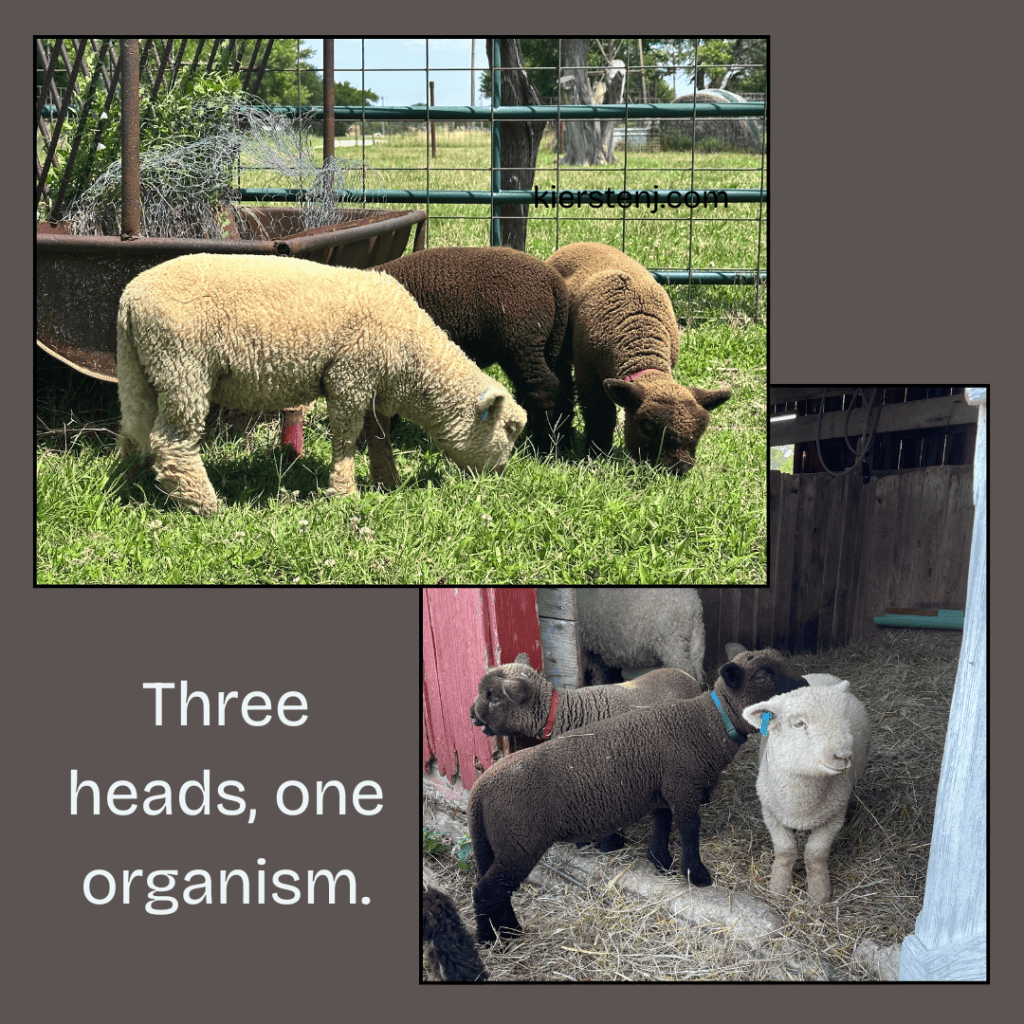
To be perfectly honest, I’m not the slightest bit embarrassed by my helicopter habits. Watching the Hooligans sort themselves out has been fascinating.
Part of it is because this little group has the potential to play an important role in the flock. These are all youngsters, with the oldest, Harriet, only eight months old. Four of them are wethers, and the three ewe lambs cannot be bred to our rams (their sires), so for now they’re a non-breeding group.
In the Fall, this group will be the group that stays in the main barn and paddock during breeding season. The mature ewes will go, by breed, for two-month visits to their ram. We’ll stagger the breeding visits so lambing is (theoretically) manageable, which will mean a lot of shuffling about in the barn population.
The Hooligans will be the stable group that stays throughout all the changes. That makes me very interested to see how this sub flock navigates the changes and establishes its own bonds.
Daytime and nighttime observations showed three initially separate groups: The three-headed Mardercas, the Valais lambs (Eliza, Betsy, and Fitz), and Harriet.
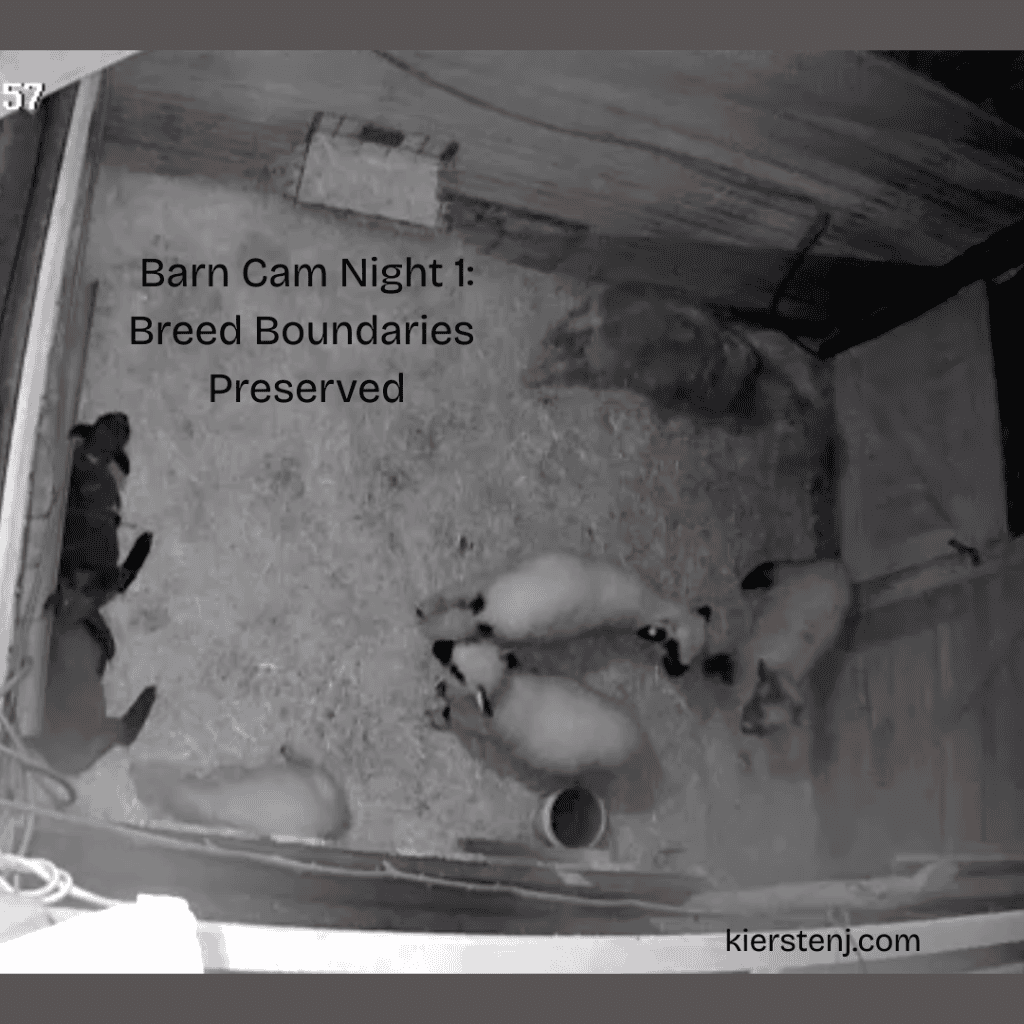
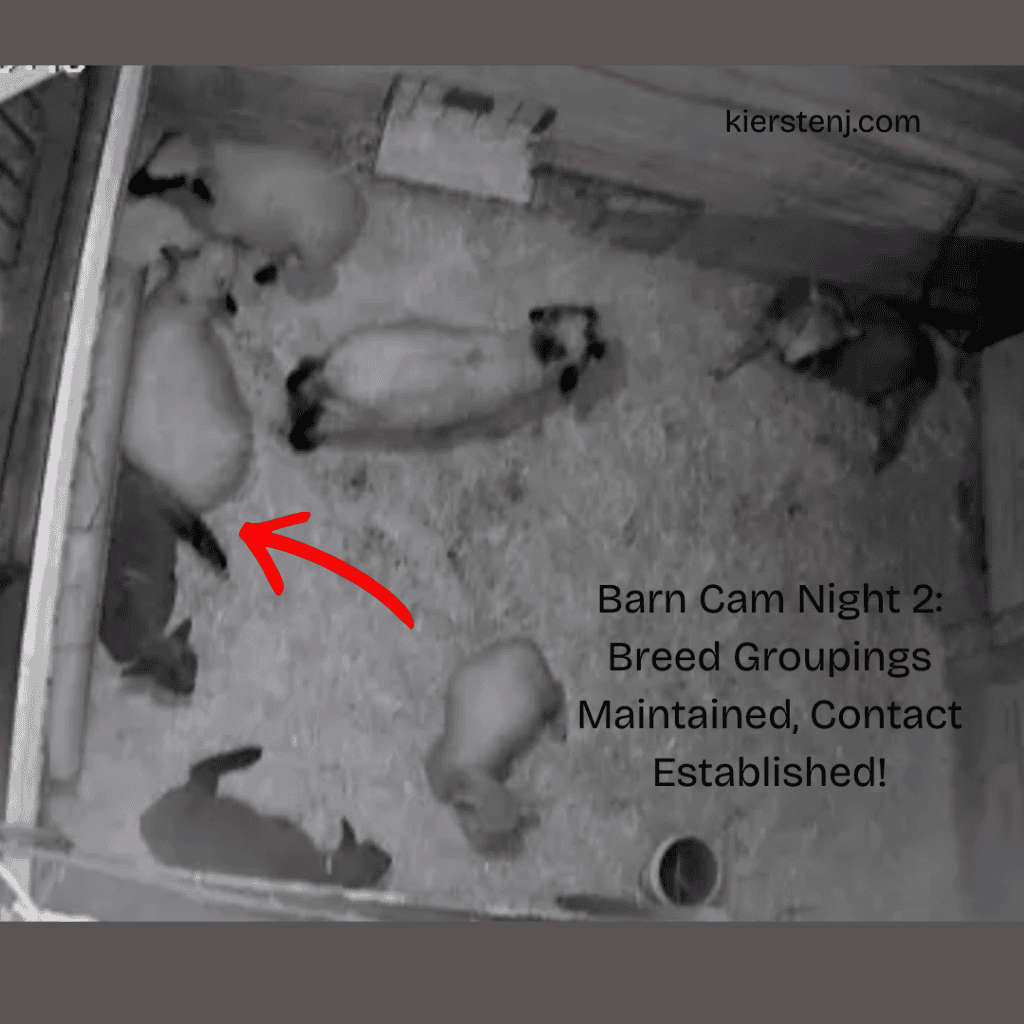
Slowly, these groupings started to shift. Fitz broke out from the Valais group and started occupying middle spaces. Then Martin followed suit. Within a week, all seven seemed to feel comfortable enough to mix during day and night.
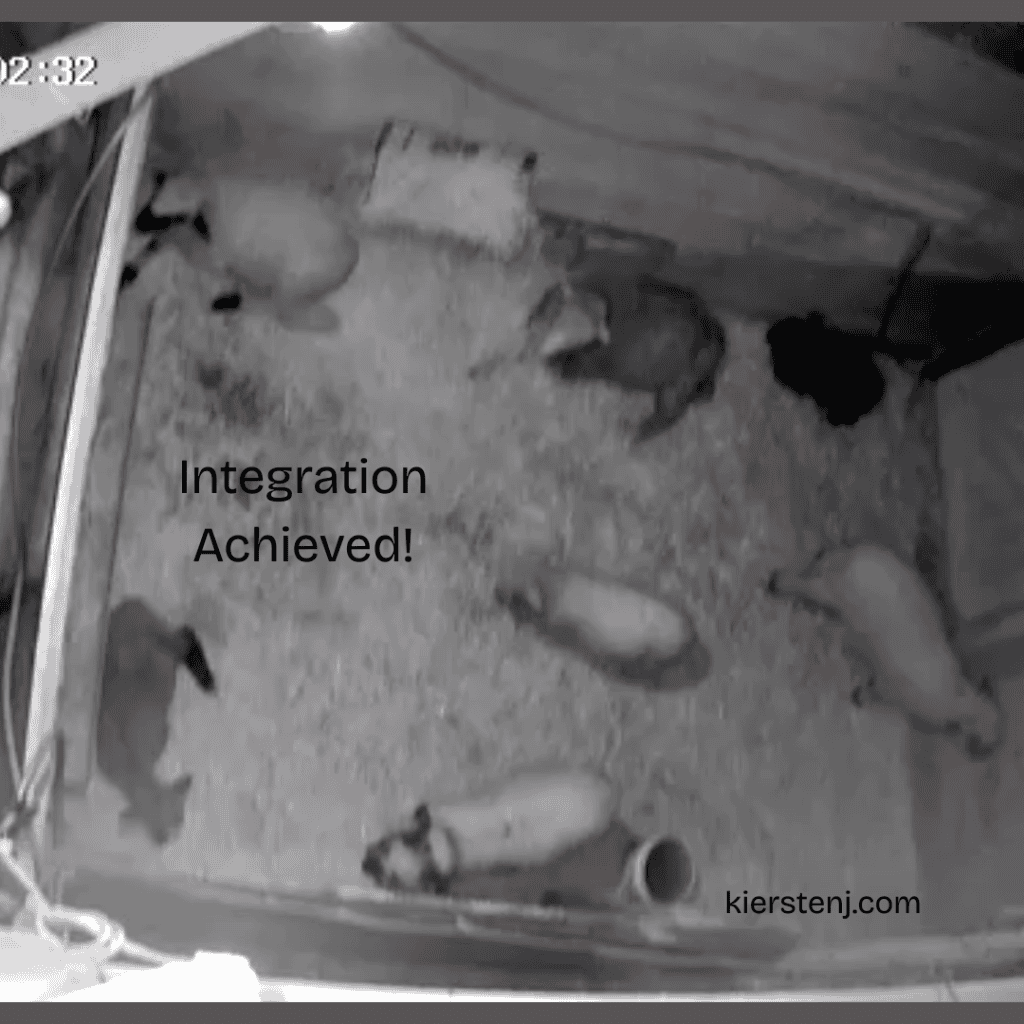
It’s fascinating to watch the individual personalities continue to reveal themselves as these creatures find their place in the flock.
Eliza and Betsy have always preferred one another’s company, with Eliza slightly more outgoing and Betsy more food-focused. I watched Betsy gently establish herself in the pecking order with the young lads near the hay feeder on the first evening. These twins almost always choose to snooze bunched up together at night.
Harriet is the slightly frazzled older sister that occasionally snaps. Eighty percent of the time, she is perfectly pleasant as long as you give her enough space. The other twenty percent of the time she acts like she’s perfecting an NHL-level body checking technique. Anyone is subject to being plowed at any time. Everyone understands and accepts this about her.
Fitz is the floating friend. He’s happy to spend time with anyone, is a little wary of Harriet, and I don’t think the idea of butting someone out of his way has ever crossed his mind.
Martin is Mr. Chill. He is not fazed by Harriet one iota. He goes to eat hay right next to Harriet every single night with no fear in his pure heart. Most nights, all is well in the kingdom. Some nights he gets plastered into the corner. Some nights he gets plastered more than once. He simply comes right back to the exact same spot. Munch much munch.
Lucas is the adventurer. Where he once used to check every living (and some not-living) thing as a potential source of milk, he now has assigned himself the role of Official Explorer. This role includes fence-hole revealing, empty stall exploring, and the claiming of Harriet’s Bathtub. She tolerates it. Mostly.
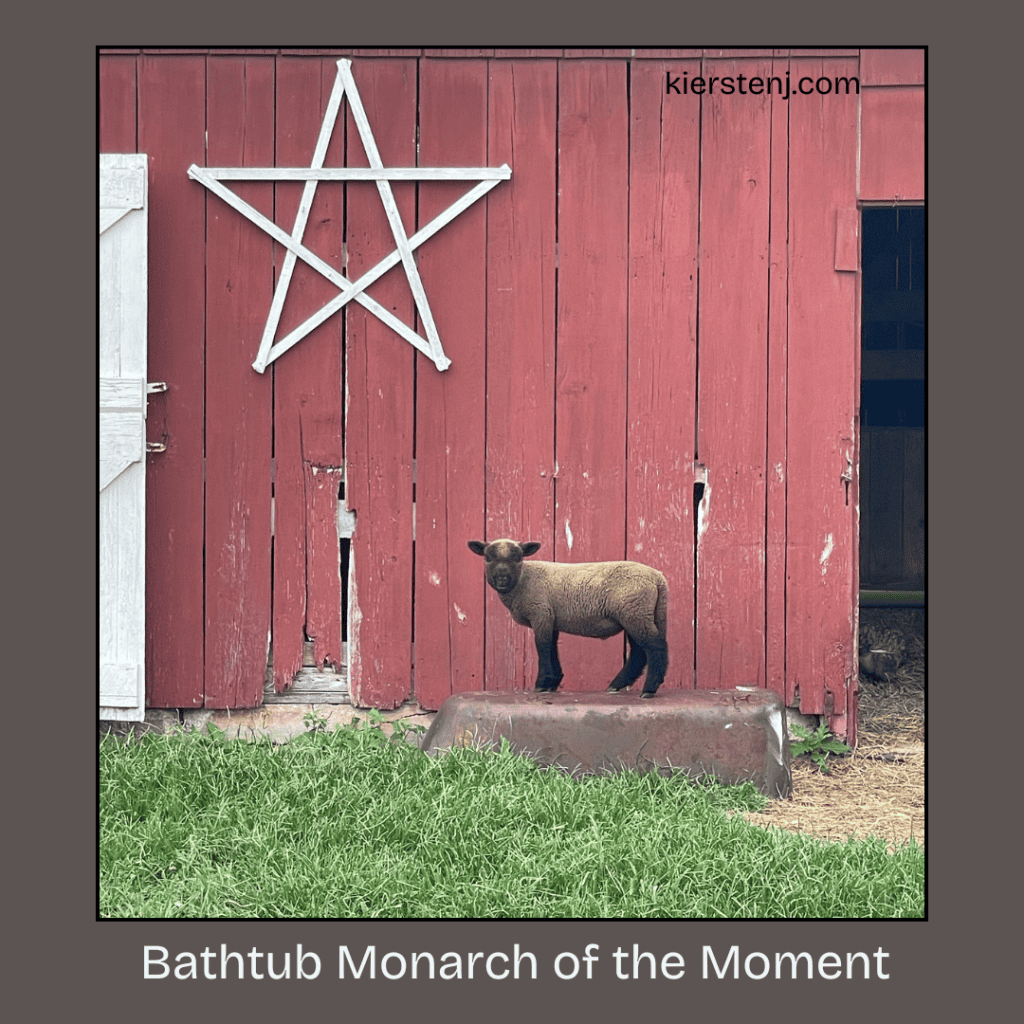
Frederick has also acquired a title. He is the Official Chairwether of the Clean Your Plate Club. Every other sheep in the barn likes to sample feed from different parts of the trough during evening feed. Not Frederick. He has assigned himself an area. He does not leave the area until the area is sparkling. Even when Harriet plows him into the wall, he calmly directs himself back to his Exact Area like his nose has a homing device. When he has completed his job, he works on the nearby areas, calmly and methodically. I’m thinking about mounting an Award above his spot.
We’ll probably turn off the Barn Cams soon. There’s really no need for them until lambing season starts up again. But I don’t think I’ll ever get tired of watching these little creatures develop and interact with each other.
We finally watched The Sheep Detectives last week. I enjoyed seeing someone else’s version of sheep thoughts. Have you seen it yet?
Greg’s Got Questions
Thank you to those of you who participated in the last poll!
The winning question was: How old does a lamb have to be to be weaned from its mom? Does it vary by breed?
There’s no official correct answer to this question. There are lots of reasons to wean earlier or later, and no shortage of opinions on the subject.
The factors that are in play include: the lamb’s ability to get nutrition from non-milk sources (feed, forage), the lamb’s weight and general health, the ewe’s condition, the condition and amount of pasture available, the timing of the next breeding cycle, and other stressors to ewes and lambs.
It is possible to let a ewe/lamb pair work out weaning all by themselves. Sometimes this works out well, and the ewe basically manages the lamb and tells it when enough is enough. We saw the downside of this method with Emma and Harriet. Emma was not putting her hoof down, and Harriet was quite demanding. This resulted in Emma melting away into a shadow, while Harriet was still nursing like a champ at five months and contorting herself to fit under her mother. We chose to wean Harriet because Emma’s health was deteriorating.
We learned from Emma’s weaning that the separation is very stressful for both ewe and lamb. With the Valais and Babydoll trios, we wanted to try to mitigate that a little bit by weaning the lambs in groups. That way, they’d at least have known companions with them in the new environment.
We hoped to make it to at least eight weeks for the youngest lambs in the groups. That’s technically considered early weaning. The biggest reason we weaned early was ewe condition. Lactation takes so much energy from the ewes and most of them came to us underconditioned.
We manage early weaning by making sure the lambs have plenty of feed, hay, and pasture, and we watch them carefully to make sure they are not losing condition. We also made sure they were consuming feed, hay, and grass very well before starting weaning.
My hope is that by intentionally managing breeding and lambing windows this year, and by carefully watching the body condition of the ewes before breeding, we will be able to extend the time the ewes and lambs can be together next year while keeping everyone healthy.
Greg’s Questions for Next Week
(As a matter of procedure, the poll function takes you to another page to submit your vote, so if that happens to you, you’re on the right track!)
Question 1: If we were to invest in more barn cams, what would part of Pemberley Farm would you Helicopter Shepherd over next? Which leads me to sneak in a bonus question: If you’re next surveillance target is The Regiment, what do you call one who helicopters over chickens?
Question 2: Before you landed on “Mardercas” as the smooshed together term for the 3 boys, what options didn’t make the cut? And how do you pronounce “Mardercas”. (Again with a snuck-in bonus question.)
Question 3: How much of Harriet’s behavior do you attribute to her unique personality and how much is because she’s a Merino?
Happy knitting,
Kiersten J