Check My Math
Did you love school as a kid? I really did, and I loved Math. I had great teachers who encouraged me and my fellow math-loving students to push ourselves beyond our grade level to keep learning and exploring.
I continued loving Math and Math-dependent Science classes with a pure heart up until sometime in high school when a strange phenomenon occurred. Every once in a while, I’d come across a complex problem for which I’d come up with a different solution every time I worked through it. It completely blew my confidence to smithereens.
And how, one might ask, would I know I kept getting different wrong answers? Because 100 years ago, when I was in school, our textbooks would have the answers to the odd-numbered problems in the back of the book. Like any self-respecting Type A perfectionist, I checked every blessed one of my odd-numbered problems in the back of those books, because who leaves free points on the table?! I mean, really. Grades are part of our Permanent Record, after all.
Did any of you have the foundation-shattering experience of finding an error in an answer key? I did. Holy moly. There is nothing pretty about a teenage girl having an epistemological crisis over a physics solution manual error. Hormone fluctuations and uncertainties regarding the foundations of knowledge are a bad combination.
I suspect this experience may be at the root of switching majors from Chemistry to Philosophy after my sophomore year of college. At least, it’d be nice to frame the story that way. “I became fascinated with how we come to know what we know and with discussions about certainties and experiences and what is and is not universal” sounds so much better than “I went through 3 notebooks, 27 pencils, and an entire box of tear-soaked Kleenex before I finished the practice problems for one chapter. Every chapter.”
I still like Math, but we have trust issues. I still work important real-life problems multiple times to see if I get the same answers. I still have the hoodoo on me, because sadly, sometimes I do not.
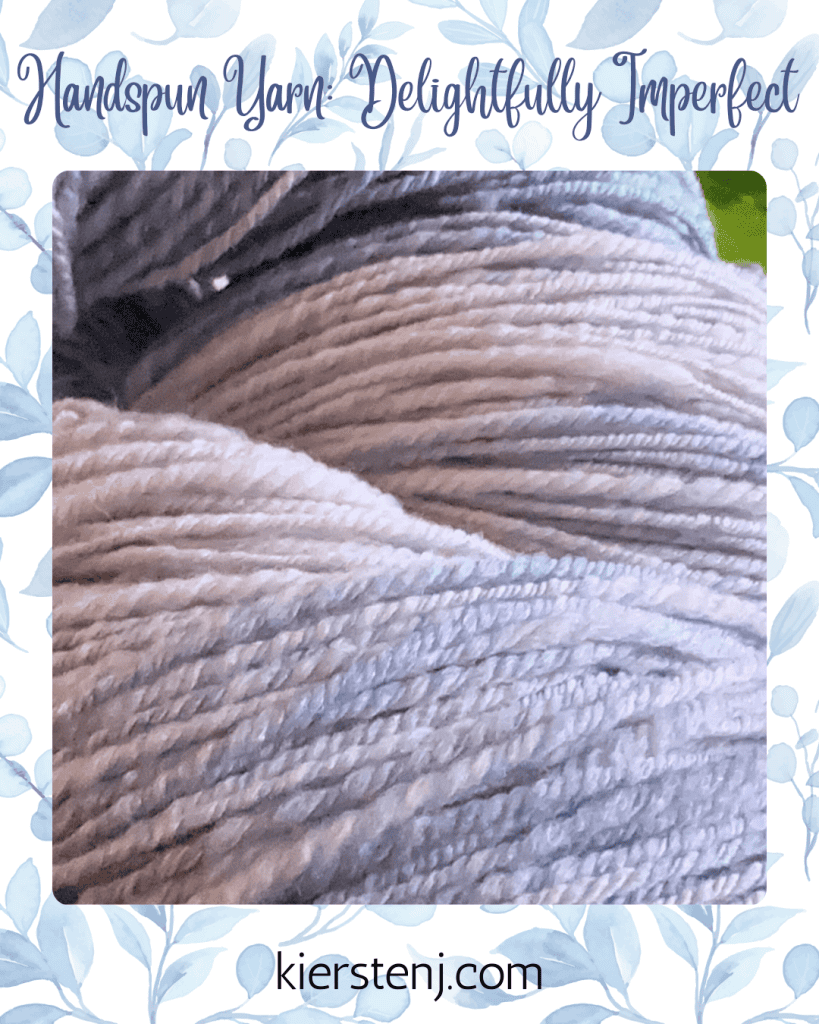
Here’s an example: I am very excited to be a vendor at both the Kansas Homeschool Expo and the Texas Homeschool State Convention this spring. I’m planning on giving away bookmarks with QR codes for the free sample lesson folks can try and see if they like the format, etc. I thought one way to make the bookmarks more fun and memorable might be to attach some handspun yarn as a tassel.
Great! No problem. I asked The Robut, based on expected foot traffic, how many bookmarks I should prepare. The answer? Five hundred.
I immediately had visions of non-stop spinning for the next three months. Five hundred. Wowzers.
Then, about two ounces into the first braid of roving, I realized I needed to chill out and do some mathing. I usually get over 200 yards on a “normal” spin of four ounces of fiber. That’s 600 feet. It’s not going to take more than one foot of yarn for a very simple tied on bit of yarn on a bookmark.
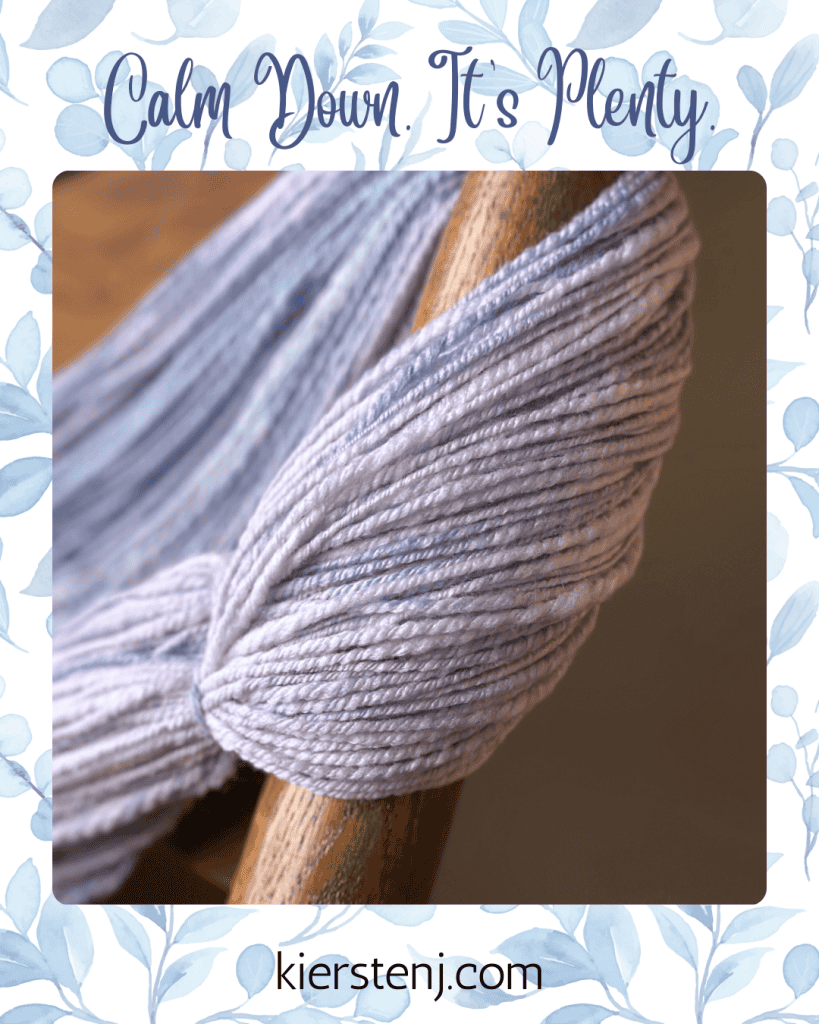
In fact, considering I ended up with well over 230 yards, I should have enough for 190 more bookmarks than the 500 I’m planning on.
Right? Does that math check out to you? Where’s an answer key when I need one?
Here’s a math problem that won’t make sense until you see the pictorial representation of the sum.
One (Mr. Knightley) plus one (Emma) equals one (Harriet).

Join us in welcoming our first Pemberley sheepling, Harriet, a very healthy, frisky, adorable merino ewe.

Greg’s Got Questions:
Thank you to those of you who participated in the poll last week!
LAST WEEK’S QUESTION:
Which is easier for beginners to learn, knitting or crocheting?
Knitting! I say this as someone who learned how to crochet first.
If you happen to learn crochet first, knitting is going to come to you easily, because you have already mastered the most important mental and physical concept: bringing new loops through old loops.
Knitting is easier to learn because you are making one wrap and pulling it through one loop. That’s it.
In crochet, you make a wrap, pull it through a loop, make another wrap, and pull that second wrap through two loops (one the first wrap you made).
Neither is terribly complicated, it’s just that crochet has an extra step. Additionally, that first wrap can sometimes be twisty or tight until you’ve learned how to master your tension, which can make that second step physically more difficult.
One other advantage to knitting for beginners is that there is rarely a question about where to start and end a row with knitting. All the loops are held on the needle, and when you run out of loops, you’re done. You start the next row with the first open loop. In crochet, it is easy for beginners to miss the very first stitch of a new row, or to accidentally miss the last stitch of an old row. Knitters can make mistakes that are similar by knitting into the front and back of the first stitch of a row accidentally, but my experience is that this is more common for beginners learning to crochet. In either craft, counting stitches every row can help prevent adding or subtracting stitches.
Greg’s Questions for This Week:
Here are the questions up for the vote this week. I’ll answer the winner in the next newsletter. (As a matter of procedure, the poll function takes you to another page to submit your vote, so if that happens to you, you’re on the right track!)
Question 1: Which of the many connections between Math and Knitting are your favorites?
Question 2: What learnings from your Chemistry major days do you find most applicable to Fiber Arts? (And if you could have skipped Organic Chemistry, would you still have changed your major?)
Question 3: Why did you pick “Harriet” as our cute little new baby sheep’s name? (Yes, I know NOW, but I didn’t until you told me. I’m sure glad you weren’t aware of my ignorance in this area before you said Yes to marrying me.)
Happy knitting,
Kiersten J