Practicing Thanksgiving
It is Thanksgiving week in my part of the world.
When I was a kid, this was the kickoff week to all the fun, special events of the year. School was peppered with holiday themed activities, concerts, presentations, and days off. There were family traditions to anticipate, TV specials to look forward to enjoying again, and all the magic that goes along with holiday celebrations when you’re a kid who doesn’t have to do much of the planning, prepping, or paying for it.
The older I get, the more I realize how differently this season’s experience can be for different people. While I wouldn’t want to take away one iota of happiness for anyone who still has the blessing of innocent joy in all their holiday celebrations, I’m seeing so much more of the weight of grief, sorrow, baggage, and pain that most people know at least a taste of in their holidays.
It’s hard to admit, but I feel a pinch of dread when the holidays approach. I feel mom guilt about imperfect holidays when my kids were young, and that guilt is magnified by the fact that my first marriage failed. Those family memories have some weight. I’m grieving the losses of other family members. Greg has griefs and losses of his own.
The holidays can feel like an emotional minefield. Maybe you feel something similar.
I suspect that packing up the dogs, kidnapping Greg, running away to a secluded location, and throwing our phones in a handy nearby lake isn’t a healthy solution.
So, I’m finding it providential that this season is starting with a reminder to be thankful.
At some point in college, I was having a crisis (as one does) and having trouble sleeping. A good friend suggested that as I went to bed each night, I come up with three unique things to be thankful for. They could be big, small, ridiculous, stupid, whatever. The only rule was that they had to be real and they had to be something I hadn’t named previously.
That may be the best advice I’ve ever received in my life.
It doesn’t change circumstances. It doesn’t make bad things go away. It doesn’t make promises that things are going to be better soon.
But what the practice of thankfulness accomplishes is that it trains your mind and heart to look at the world differently.
Rather than focusing on the things that are hurting, we can choose to focus on things that are good. We can influence where our attention rests.
It doesn’t invalidate pain or loss, but it acknowledges blessing. It says, “this also is part of reality.”
We all know of people who feel like the world is set against them and are full of bitterness. We know of people who have truly had extremely difficult lives and yet are full of joy. What accounts for the difference?
I don’t know the full answer to that, but I suspect that part of it has to do with where they focus their attention. Is it on their grievances or on the good they’ve received?
There is medical evidence to support the health benefits of gratitude, including how the practice of it can regulate our nervous systems.
And so, as we enter this holiday season, I’m restarting my practice of thanksgiving. Would you like to join me?
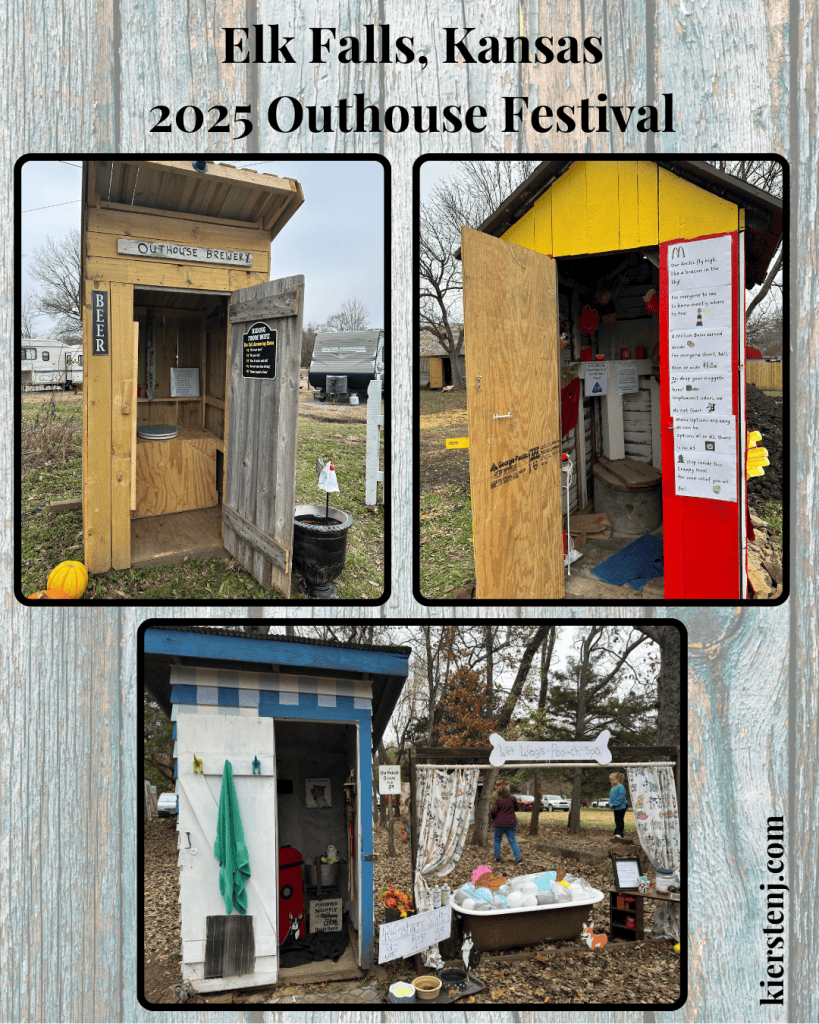
- I’m thankful that I live in a world that has such things as Outhouse Festivals (really!) and that I happened to run into an old, dear friend I hadn’t seen since college while I was there.
- I’m thankful to have found a sweater pattern Greg likes the look of (Auster Pullover by Michelle Wang) and plenty of yarn already in the stash that he also likes and will work perfectly. I am mowing through the stash yarn, and it feels great!
- I’m thankful for each of you and your willingness to allow me to share some of your precious time and mental space. Thank you.
Greg’s Got Questions:
Thank you to those of you who participated in the poll last week!
LAST WEEK’S QUESTION:
Which of the many connections between Math and Knitting are your favorites?
I have two favorites, and sadly, I have to look both of the concepts up every time I use them. Math concepts aren’t very sticky in my brain!
The first one has to do with making circular or half-circular shawls and actually using pi and the area of a circle and the circumference of a circle like we learned in school. It tickles me because of all the applications for using math in real life, I never ever ever would have thought that I’d use it for designing knitting patterns. But I sure enough have.
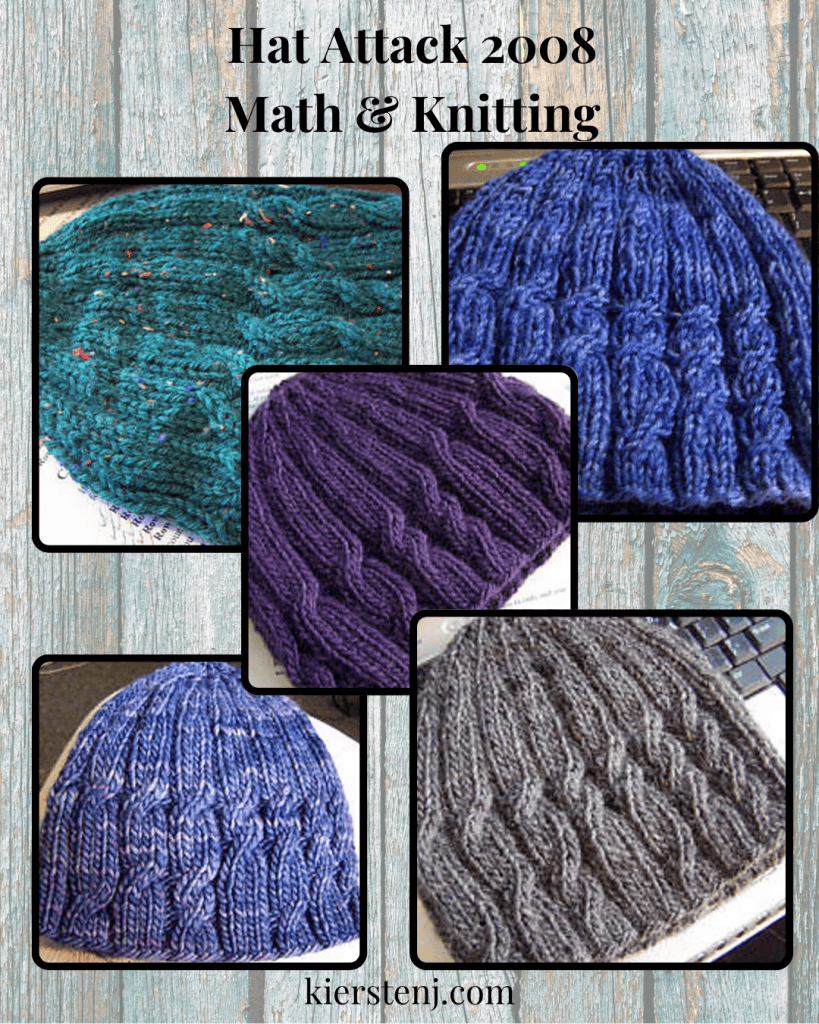
The other connection I love is one where a math nerd used her love of math to inspire a pattern for a knitting game/competition I participated in back in 2008. It was called Hat Attack. The details are fuzzy, but the idea was that a whole bunch of people from all over the world started a hat at the same time. As soon as we finished it, we mailed it off to our designated target. If we received a finished hat, we were “dead” and out of the competition. We had to mail our unfinished hat to the person who’d taken us out and they’d finish it and send it to take out our target. I think I finished 4 before I was taken out and I ended up making another one to keep because the math nerd part was cool. It was a cabled hat based on the Fibonacci sequence.
Greg’s Questions for This Week:
Here are the questions up for the vote this week. I’ll answer the winner in the next newsletter. (As a matter of procedure, the poll function takes you to another page to submit your vote, so if that happens to you, you’re on the right track!)
Question 1: What are you most excited about in using the sweater patter you picked out for me? Is there anything especially challenging with this project?
Question 2: What tips would you offer those wanting to start a thanksgiving habit? What worked best for you?
Question 3: If we were to run away to a secluded location and throw our phones in a lake, where would we go?
Happy knitting,
Kiersten J