Sticking Tight
Last week’s winning poll option was all about the stick-tights.
It turns out that stick-tights may have also been slightly symbolic for the week ahead.
Flocking
Let me share with you the wonderful weirdness I witnessed this week about the flocking instinct in the sheep here at Pemberley Farm.
A group of sheep is called a flock, but “flocking” is also the word used to describe the behavior sheep and other animals use to move together as a group. Sheep are happiest as one of many. If you watch them for a while (and nothing startles them) you’ll notice that even if they spread out in a field, they’ll drift as a unit. If one startles and bolts in one direction, the rest will follow and the group will tighten up, though most of the sheep may have no idea why the first sheep was startled.
Shepherds use this instinct to their advantage when moving sheep around, and if you’ve never had the opportunity to see sheep dogs in action, please consider taking a moment to watch a drone video like this one. The combination of herding instinct in the dogs and flocking instinct in the sheep is simply breathtaking.
I am the dog on our farm.
I do not have awesome herding instincts. No breaths are taken from anyone’s lungs but mine on our roundups.
What I am learning is that the two journeys the wee flock and I make every day are very different in nature and leadership requirements.
The trek from the pasture to the barn at the end of the day is child’s play. A chicken could do it, if it could only open the gate. I am thoroughly qualified for this task. Once the gate is open, Kitty makes a break for the barn and the feed she knows is waiting for her inside. The rest of the flock, true to form, follows the movement, charges along the lane into the barn and starts chowing. My job is to catch up and close the barn door behind them.
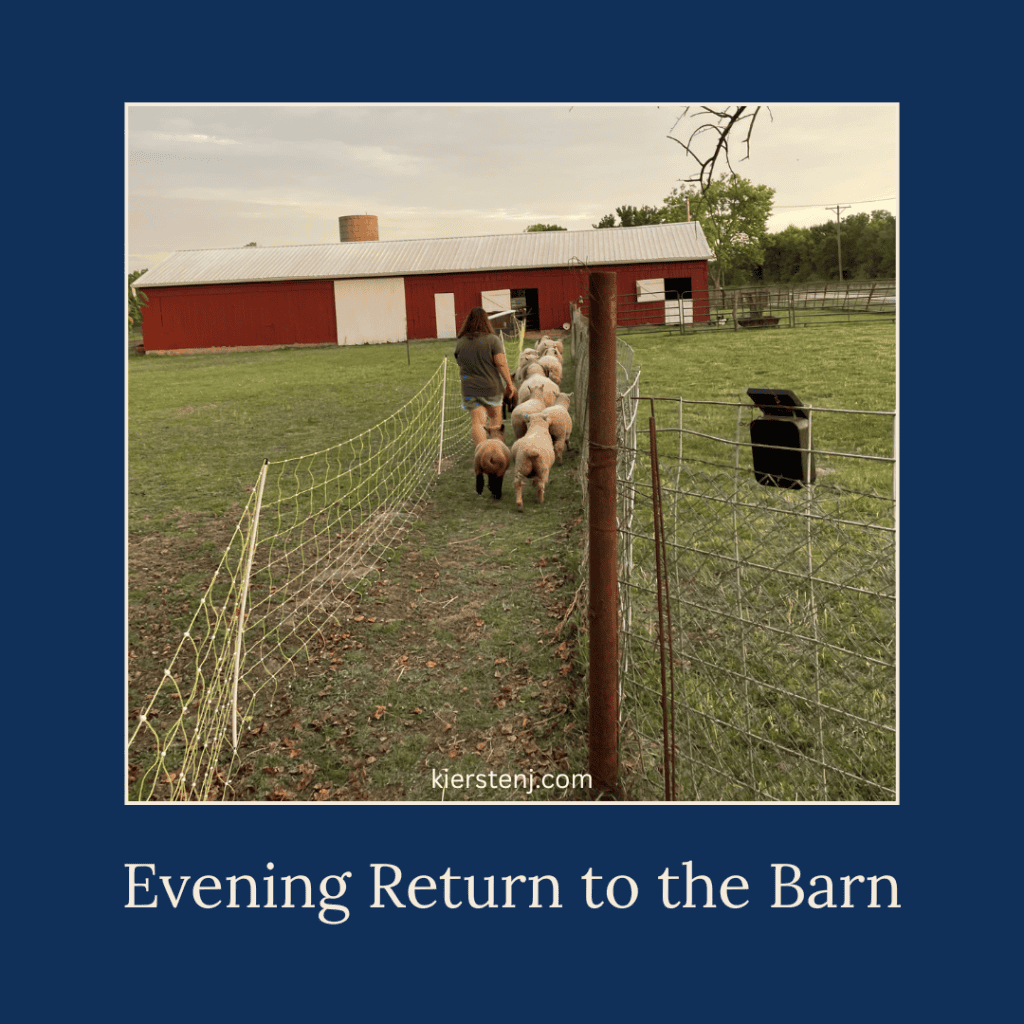
The morning walk to the pasture is a different story.
I tried opening the barn door and letting them walk up the lane to the open gate and wide-open pasture. Surely, they’d be enthusiastic about all the delicious green forage and fresh air and happily galumph away with good cheer, right?
Wrong.
They made it about 25 yards, someone got spooked, and they all then chose the “tighten up” portion of the flocking instinct.
The little annoying stick-tight seeds that the sheep collected in their wool have done some interesting things in the last week. It’s not universally true, but for many of the sheep, those seeds have migrated into tightly packed clusters on the outer part of the wool. While some will need to be combed out (as one kind reader helpfully suggested), these thicker wadded masses of seeds will need to be clipped out.
What I had at this moment of the morning walk was a wadded mass of sheep blocking the lane. They were packed tightly and not particularly interested in being removed from their present location. At all. No amount of gentle nudging was going to help us make any further progress.
After squeezing through the sheep equivalent of NYC’s 5th Avenue, I started walking towards our goal.
And this is part of shepherding that feels magical to me: The sheep followed.
I know this is part of the flocking instinct. It only takes movement from one sheep, and the rest of the flock is likely to follow. But you still have to get one sheep to walk away from the group and follow, and that’s where the magic lives.
I think I called to Georgiana. I figured I had the best chance of attracting the attention of the Queen, who is almost always amenable to attention. But it wasn’t Georgie who first stepped out of the sheep congestion to walk toward me. It was Lizzy.
Grumpy, skittish, Babydoll-thumping Lizzy. And one by one, the rest of the sheep unpacked themselves from their sheep scrum like nothing traumatic had happened at all and calmly walked to their morning feast.
From that day on, I determined I’d be leading the sheep out along the lane in the mornings. I marched in front of our daily morning parade and enjoyed seeing the flock follow calmly behind and then spread out to enjoy the grass when we arrived at the pasture.
Someone suggested I might like one of those huge whirleybobs that drum majors hold at the front of marching bands. I wonder if I could learn to twirl a baton?
Anyway, all went according to plan until this morning, when I discovered the flaw in my “open the barn door and lead them out” plan. Sometimes, certain Babydolls get very insistent that they need to leave the barn at the very same time. Sometimes this results in getting stuck at the barn door and the door eventually getting shoved closed.
I learned this had happened when a riot of insulted-sounding MAAAAAAAAs came from far behind me and I turned to see only about eight sheep in our parade.
Drat.
I went back and released the squawkers and then realized that the spooking and flocking in the lane instinct was still working at full capacity. More squeezing through the mass of sheep, a few steps down the lane, a call, and then…
Magic.
Resting
Regular readers may remember we’re working our way through severe anemia with a couple of our lambs, Fitz and Eliza. We’ve been warned it’s a long recovery process with ups and downs, and we’re finding that to be true.
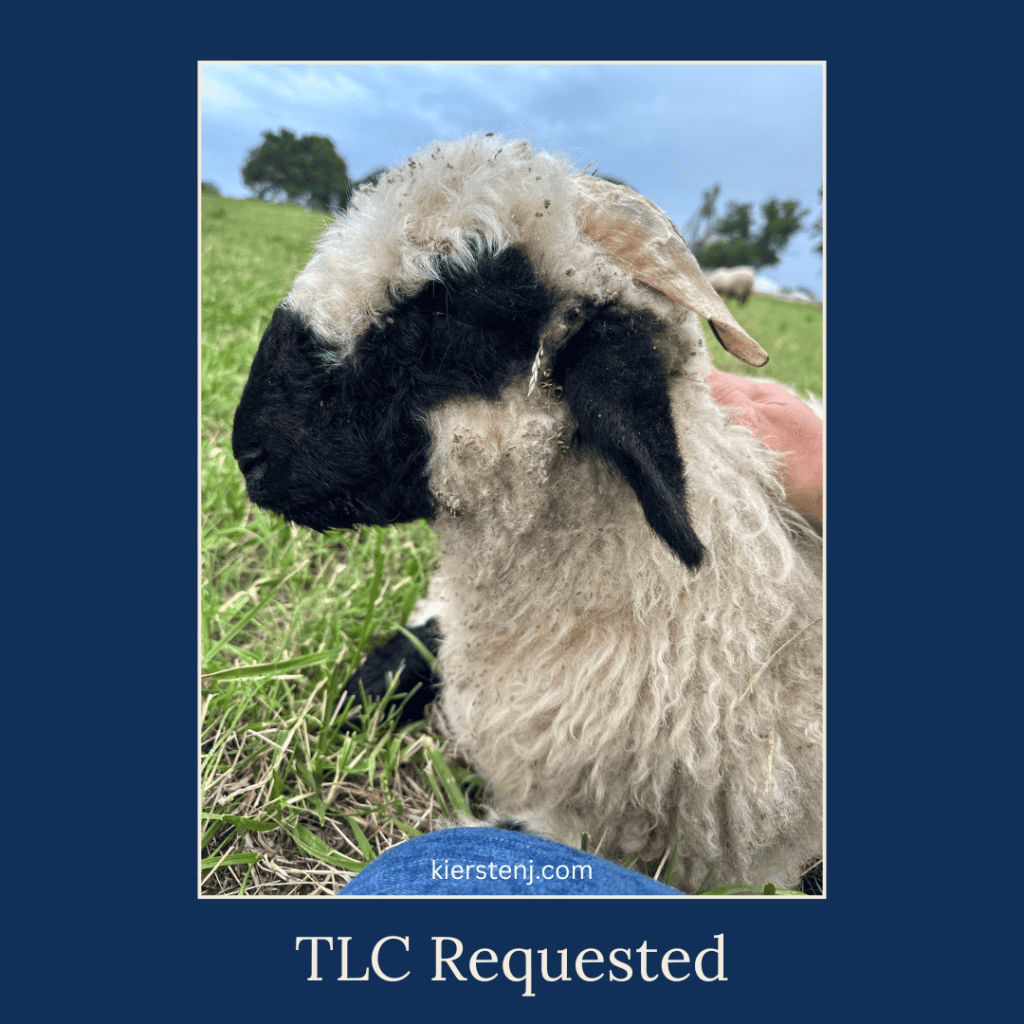
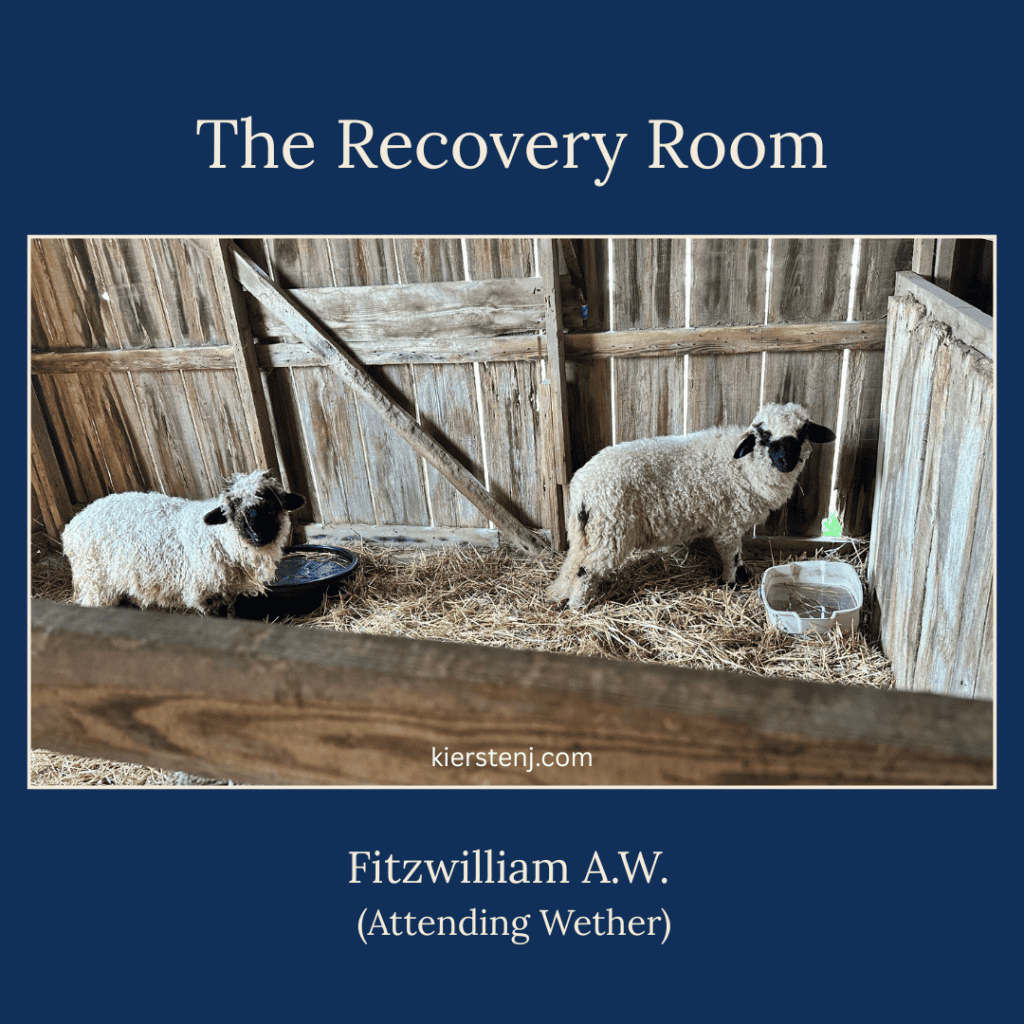
We think we may have been asking too much of their systems to be making the walk to the pasture and back each day in the heat while they were trying to rebuild their red blood supply. Eliza let us know in no uncertain terms that she wasn’t doing well after one of those walks, and so she and Fitz are now in temporary luxury accommodations.
Special treatment includes private facilities, personal fans, individual mulberry branch delivery, extra fresh water, an abundance of hay, private access to the sheep candy tub (nutritional supplement & minerals), and any petting requested.
While Fitz is also recovering from anemia and will benefit from the rest, this is the first time he is performing his official flock function as a companion wether.
Sheep are highly social animals and become stressed if they’re alone. Wethers make wonderful companions for sheep that need to be isolated.
It’s a different facet of flocking; Fitz is helping keep Eliza calm and comfortable just by being near her and acting like a normal sheep.
Stick tight, friend. We’re going to be okay.
The Literal Poll Questions
Last week’s winning questions, bundled Greg-style were: About those stick-tights and your “This is going to be an issue with the wool.” comment. How big of an issue is that going to be exactly? Based on the condition of your fancy, flowery overhauls if we have to pick out all of those things before we send the wool to the mill to be processed, we’d better get busy. Do you think you can train The Regiment to peck up stick-tights from wool like they do bugs from the straw?
As I mentioned above, one helpful reader suggested we might start combing out the seeds now, and by shearing time, the burden will be markedly less. I think this is the route we may try.
It will be interesting to see the difference between the upcoming second shearing for the Valais in late summer and the first shearing of next year. How many stick tights will we remove before the first? Will we get a clean “reset” after the summer shearing? And how many of the remaining stick-tights will be located in parts of the fleece that we’d skirt and not process anyway? We have so much more discovering to do!
Sadly, I doubt the sheep will allow the chickens to peck out the offensive seeds. However, I have noticed Frederick nibble at his own side. Maybe he’s tidying himself up a bit? Maybe they’ll do some of that for each other, as well?
Greg’s Questions for Next Week
(As a matter of procedure, the poll function takes you to another page to submit your vote, so if that happens to you, you’re on the right track!)
Question 1: About the baton twirling. Would you be willing try those on-fire batons? I’m pretty sure that’s a thing and we need to deal with that brush pile east of the barn anyway.
Question 2: Since this is the first time we’ve used a wether, I’m curious about what’s going like you expected and what’s surprising you. (Please note, for the record, I have implied a question without actually asking a question thus reducing my questions per question average that you are obviously tracking.)
Question 3: What benefits do mulberry leaves and branches have for the sheep?
Happy knitting,
Kiersten J