Free Range
“I love it when a plan comes together.”
If you heard that in the voice of a clever white-haired tactician with a cigar in his mouth and you now have a catchy theme song running through your head, you’re welcome.
I haven’t seen an episode in I don’t know how long, but boy was it a fun watch when I was a kid. I remember really wanting my parents to paint a red swoosh on the dark grey Volkswagen van we had. Couldn’t imagine why they wouldn’t go for it.
In any case, in the last week, I’ve been able to revisit that favorite line from the show as I’ve witnessed the chickens in their latest activities.
In our setup, we basically have three chicken territories. The oldest group, established layers and their miniature tyrant, Elvis, have a house and run on the southeast side of the barn. The next younger group, who might start laying in another month or so, have a house and the suggestion of a run (more on that in a minute) on the east side of the barn. The youngest group is housed north of the barn, and they’re not quite two months old.
Until recently, all of these chickens were enclosed. They had space to run around and peck at insects and plants, but they were fenced in during the day and locked in at night.
But things have changed.
Some of those changes have been deliberate. The paddock chicks were always intended to be free range chickens, with their primary duty being to eat the bugs in the pasture. I hoped they’d also find their way into the barn and go after the bugs in the big ewe stall.
They’ve grown big enough to learn how to get up and down from their little chicken tractor and have started braving the big outdoors, exactly according to plan.
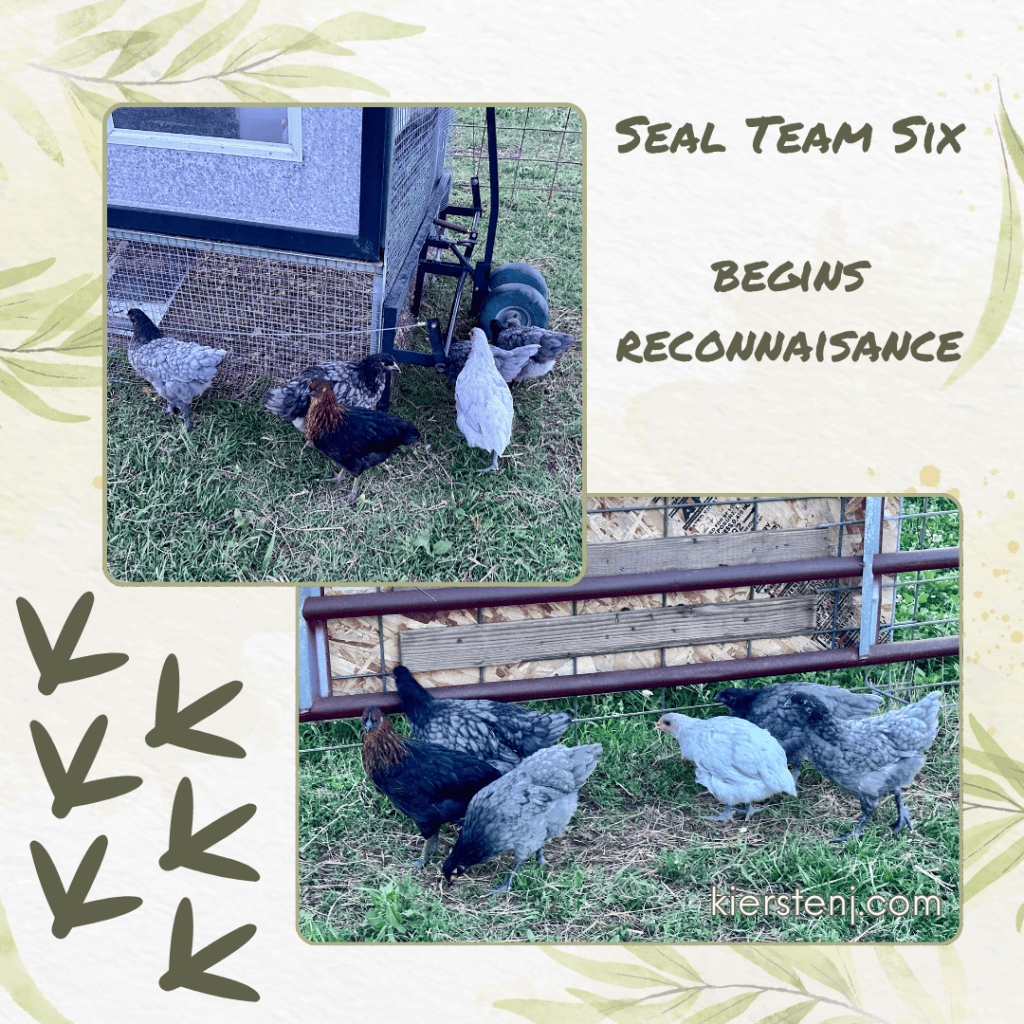
They usually operate as a wee unit of six. Their territory gets wider by the day as they explore and encounter bugs, poop, and the producers of said poop.
Frederick, the month-old babydoll lamb, is particularly fascinated by this group of smaller-than-he-is creatures. I’ve found him camped out by their little coop and watching them or sometimes following and grazing a respectful distance behind them.
Yesterday I spotted the little copper-feathered hen alone in the big stall. HOORAY!!! Let the doom of ticks, flies, and other barn creepy crawlies commence!
The other big change was slightly less deliberate, and it involved the other two chicken companies.
When we moved the middle group out of the “baby coop” and into their chicken house, we built them a…space. It’s sort of a run, in that it has a fenced boundary that ought to be understood as a limit to wandering. We even put netting around said fencing so that no chicken could possibly pass through it.
What we did not do is put any sort of covering over the space, nor did we permanently or efficiently attach said netting to the earth such that clever little chickens would not be able to tunnel and push their way under it. Nor did we consider the amount of force a motivated chicken could summon when it desired to break loose of confinement and rip netting away from the zip ties that secured it.
We first made these discoveries when we discovered Mr. Bingley with a chicken sitting on his rump.
It didn’t take long for the rest of the captives to decide that free air is the best air, and before you could say “chicken nuggets” we had free range chickens on the east side of the barn.
An executive decision was made, and the laying chickens were also granted their parole.
It’s fascinating to me that each group still maintains a sort of territorial integrity, with very little integration at the borders. Yet, the borders are dynamic.
Within a few days, the senior girls had ventured far enough to discover their way into the Barn Bug Buffet.
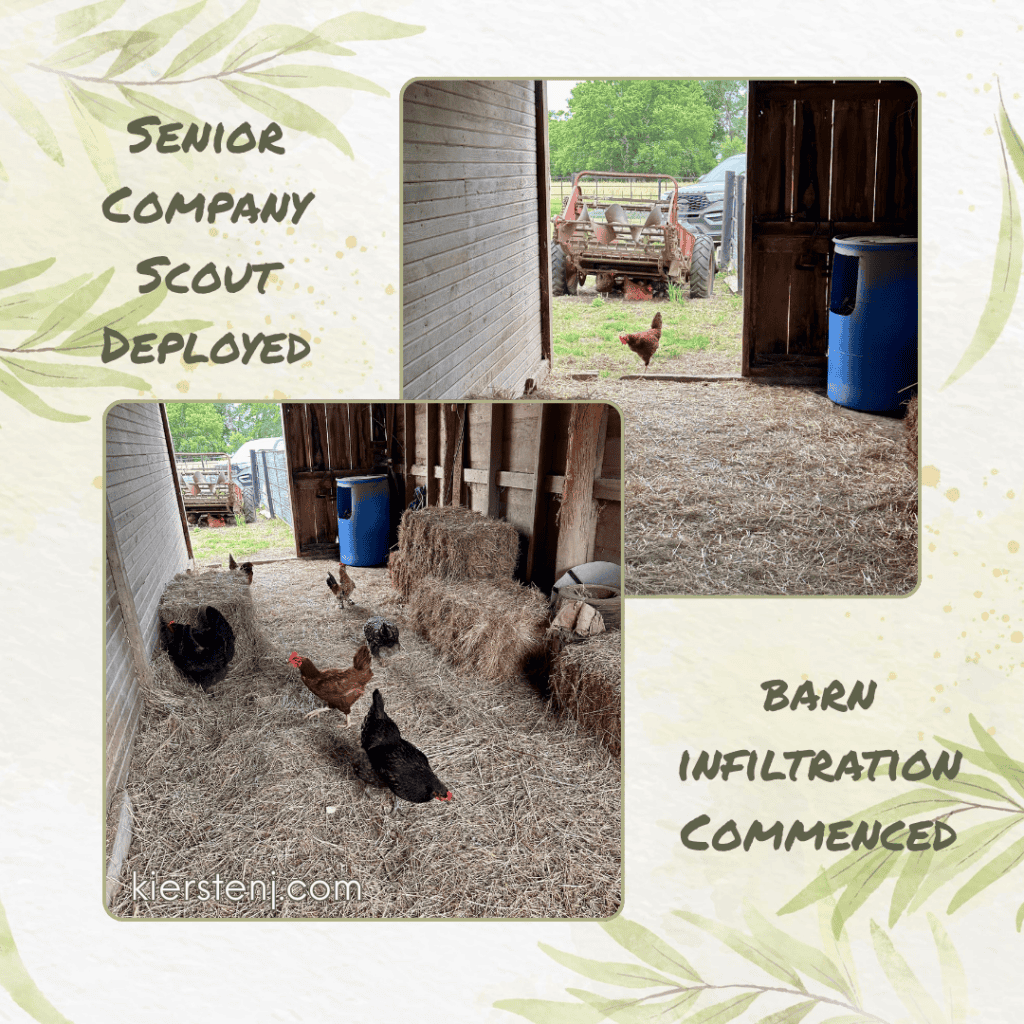
It did not take long for more girls to follow the scout into this haven of dried grass seed, spiders, beetles, and all the hay you could possibly want to kick into disorder.
They made it all the way to the gate to the big ewe stall, feasting all the way, without drawing attention to themselves.
And then…
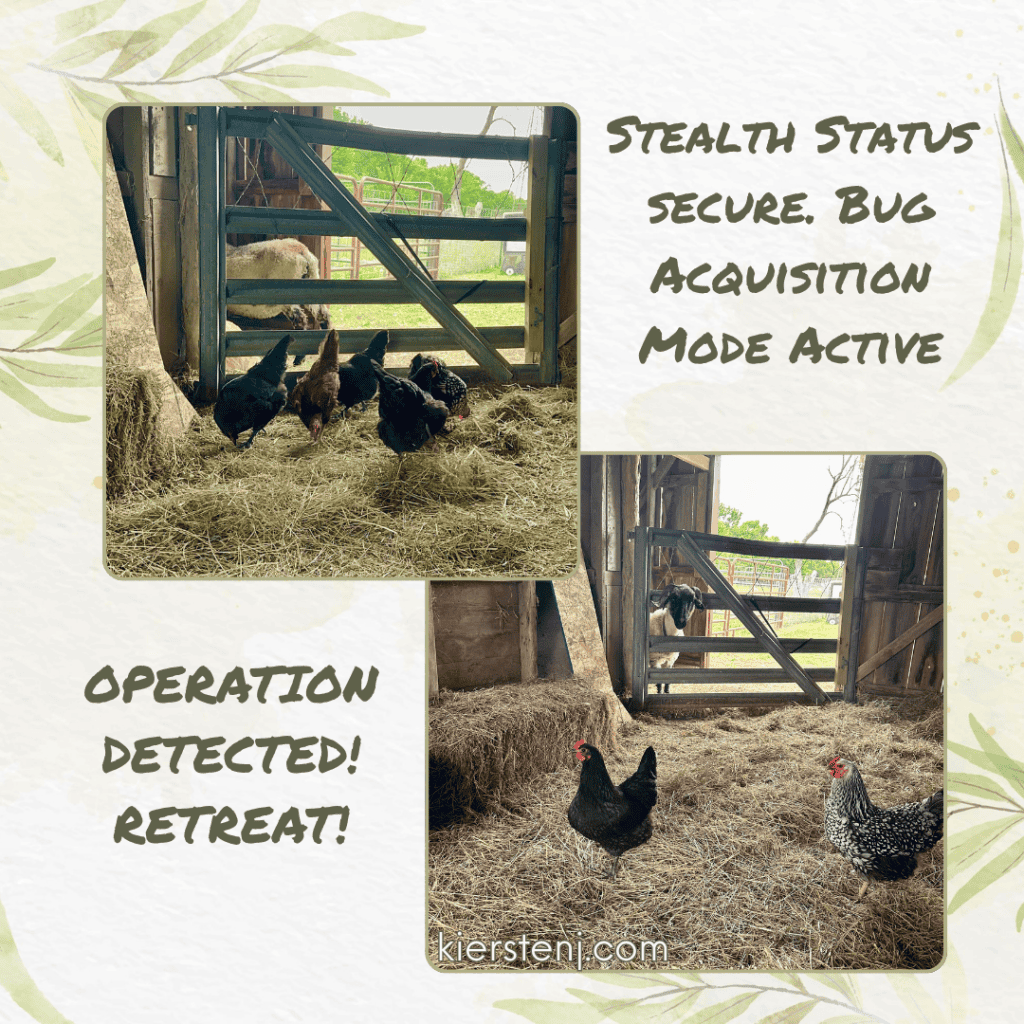
Georgiana. Of course.
Apparently, chickens also recognize her absolute authority. It’s astounding, really.
They have returned to this space as well as making regular housekeeping visits to the smaller stall with the weaned lambs and the (possibly posing as) pregnant Margaret and her faithful sidekick, Lydia.
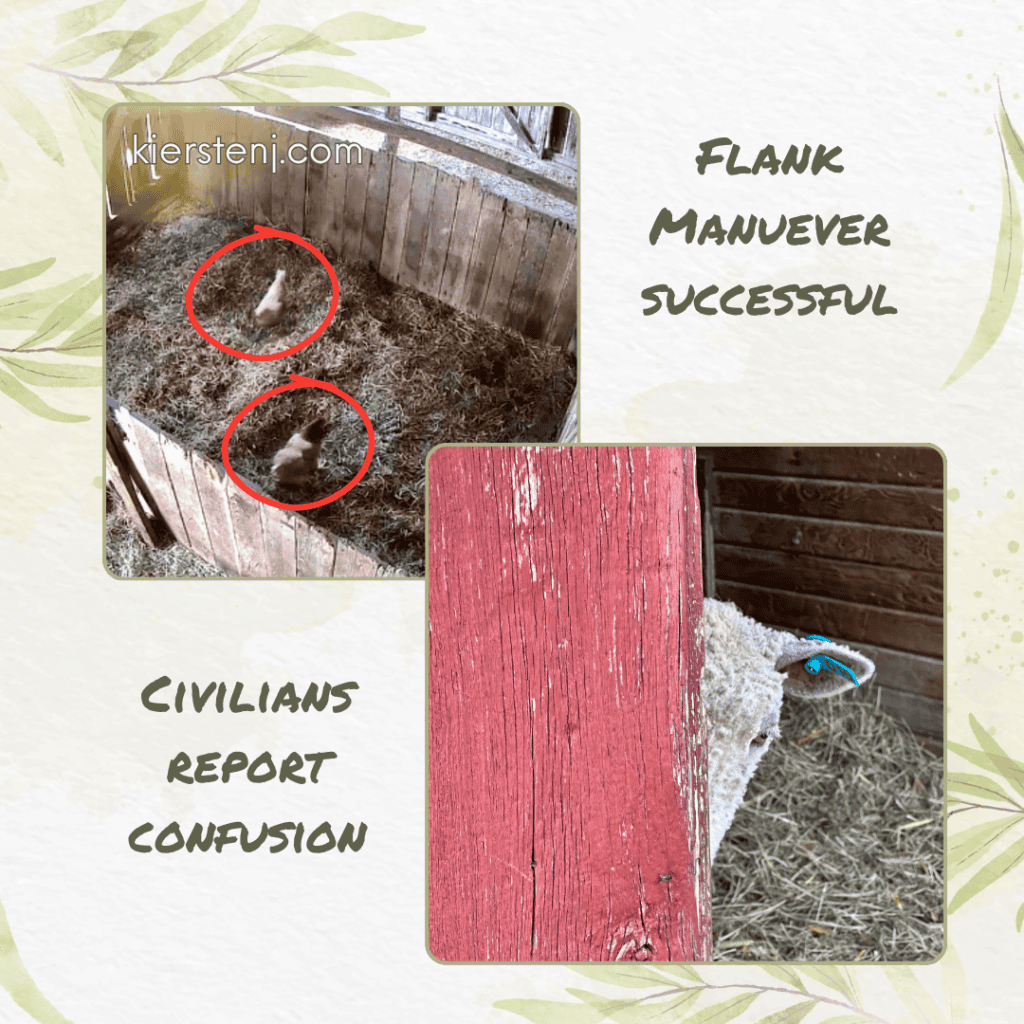
They spend a significant amount of time kicking the hay about, gorging themselves with what they find, and removing pests from the sheep quarters.
Just as I’d hoped! I love it when a plan comes together!
Now I wait for the next development. Because one thing I know: Something will happen I have not planned for.
Greg’s Got Questions
Thank you to those of you who participated in the last poll!
The winning question was: I know you’re still learning, but based on your experience so far with the whole wool processing arc, what are enjoying the most and the least?
Enjoying the least? It’s the cleaning and combing, but with a big caveat.
I love learning new things in this subject matter. After decades of reading about raw wool processing and wondering what it would be like, it’s energizing to finally get my hands in it and actually do it. And so in one sense, I am absolutely loving it.
In another, I’m not very good at it yet, and I still have a long way to go at embracing failure as part of learning and creating. I’m grateful for the opportunity to finally learn how to clean and comb wool from my own sheep. I might be even more grateful for the opportunity to practice failing and experiencing that failure differently than I have before.
But in terms of pure joy, I have to say that the sheep are still at the top of the list.
More than knitting, spinning, or any of the rest of it, I love watching them, learning how to care for them, and seeing them thrive. I love learning their individual quirks and observing them navigating their world. They are fascinating creatures and it’s a privilege to care for them for this chapter of my life.
Greg’s Questions for Next Week
(As a matter of procedure, the poll function takes you to another page to submit your vote, so if that happens to you, you’re on the right track!)
Question 1: How does what the chickens eat now that they’re running amok change the eggs they produce?
Question 2: Besides eating bugs and critters, what benefit does the constant scattering of the hay and straw by the chickens provide for the Pemberley Farm ecosystem?
Question 3: Given your 80’s action sitcom reference, which of our sheep would be most likely to utter the phrase “I pity the fool…”? To inform your thinking, I have the Roku loaded up for this evening’s post-chore viewing activity. Because you can’t say, “I haven’t seen an episode in I don’t know how long” and expect me to not respond accordingly.
Happy knitting,
Kiersten J