Honey, Do You Have a Plan?
“Wait! You have SHEEP?”
“Why do you have sheep?!”
These are the most frequent and emphatic responses I’ve been getting over the past couple of weeks. The best part about the one starting with “Wait!” is that it’s one of those sentences where any and every word can be emphasized, changing the meaning ever so slightly. I’ve heard every variation.
So, it seems like it might be a good idea to share the whys behind this dramatic midlife shift.
Fiber
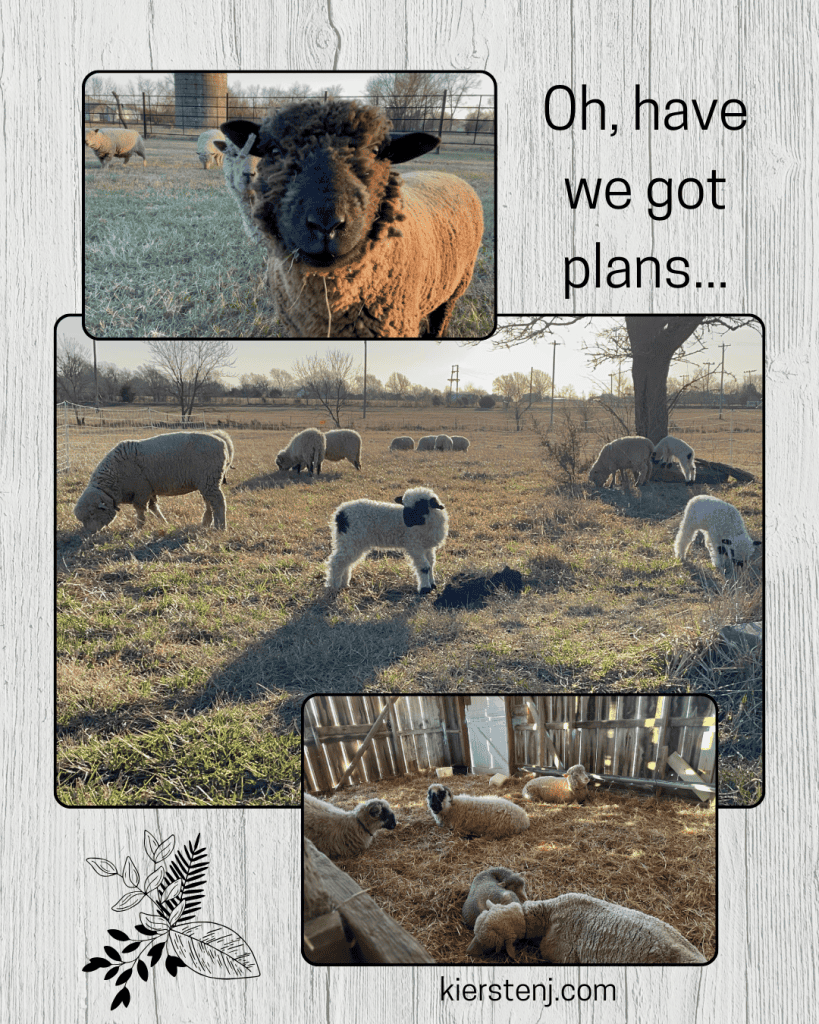
I first dreamed of owning a sheep (and yes, at one point I thought a person could own just one sheep) shortly after I learned how to spin wool into yarn. Honestly, who wouldn’t want their own personal wool factory? It’s the next best thing to growing yarn on trees!
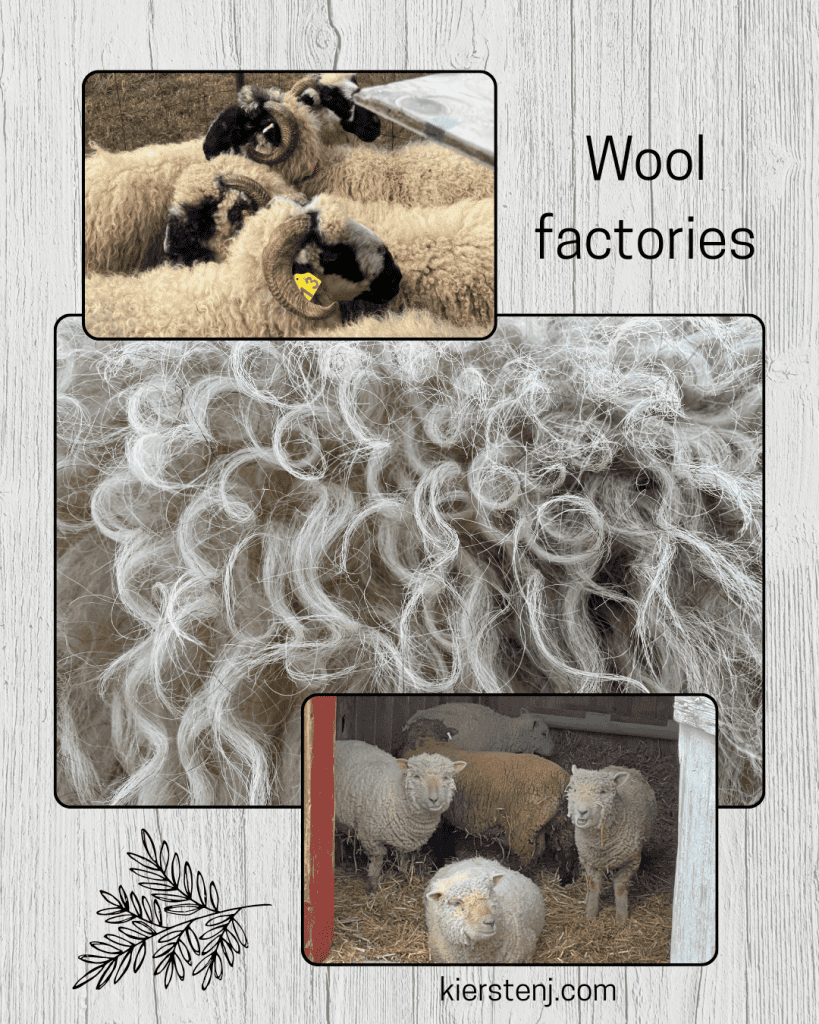
I’ve loved spinning the wool from different breeds of sheep. There are lots more I’d love to try, but Merino is definitely one of my favorites. When we had the opportunity to bring home a few Merino sheep, I was eager!
As I’ve visited yarn shops around the country and spoken to the owners, I’ve seen several yarns from folks who are committed to improving the domestic wool industry. It’s an exciting movement. I don’t have any ambitions of running a large enough Merino flock to contribute significantly to U.S. wool production, but I love the idea of taking care of the sheep whose wool I spin.
The Merino and the Babydoll wool will, I hope, work well for next-to-skin garments. The Valais cross wool is too coarse for that, but I’m collecting all sorts of ideas for weaving and felting rugs using their fleece. I think I’ll need to try needle felting a wee Valais Blacknose sheep as well, don’t you?
Education
Most of you have heard by now of Beast to Blanket, the curriculum I wrote and teach to make Fiber Arts accessible for children and adults. In those classes, we spin wool into yarn using drop spindles we make.
The first time I taught the class, I only had access to clean, combed fiber, and that’s what we used. It was absolutely fine, and it was a new experience for almost all the children. But the last time I taught the class, I had samples of wool from each of the sheep for the students to study.
They were dirty, smelly, and wonderful. The children saw the differences in the wool between the breeds, and even between sheep of the same breed. Several of these children had had no exposure to sheep at all before this class, and the wool served as a tangible bridge to a new world for them. (We are pleased to offer these wool samples now for others to use in their own classrooms, as well!)
Having these sheep nearby is giving me the opportunity to explore and expand the “Beast” end of Beast to Blanket.
The sheep are also providing inspiration and material for other educational projects.
I wanted to provide some material and resources for students who are a little young for Beast to Blanket, and now we’ve got some packets I’m offering on Teachers Pay Teachers and on Kit (Meet Three Sheep and Fiber Arts Coloring & Activity Pages).
I’m also starting work on a Science-focused curriculum that aligns with Beast to Blanket’s tone and scope. I’m so excited about it, both because of all I’ve had the opportunity to learn, and because of the potential I’m seeing to incorporate observational science and study in this intersection of fiber arts and life with sheep.
Joy
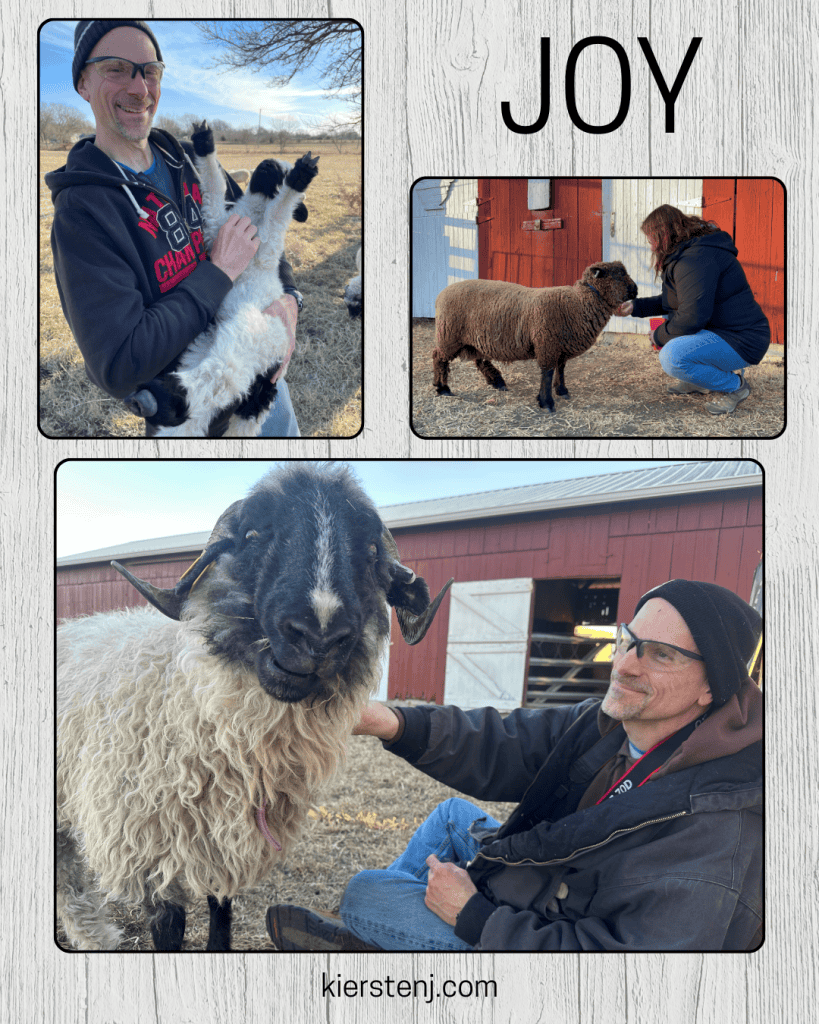
I can’t deny the cute factor. And I can’t quite explain how satisfying it is to watch the sheep grazing in the pasture or feel the lambs nuzzle at my hands. I’m not sure I even want to try.
But there’s another aspect of “growing my own wool” that is deeply gratifying.
Spinning wool into yarn is all about de-industrializing a process. It’s taking something out of a fast, mechanical process and putting it, literally, into one person’s hands.
It’s inefficient, slow, and intimate. How much more so when you know the sheep by name? When you watch them grow from lamb to first shearing? When you wait months, or (most often) a year for your supply of wool from each sheep?
What’s it going to be like to wear a hat made from Emma’s wool? Or socks made from Lydia and Lizzy’s wool blended together? How cool will it be to have a rug in my home made from the locks of the Valais ewes?
Those objects will carry more than the hours spent designing and making them. They’ll remind me of the individual sheep themselves, and the days of care and company we’ve enjoyed with them.
This evening, we spent a long time rubbing down the lambs, enjoying their snuggly personalities and soft, soft wool. Years from now, their wool won’t be so soft, but woven into a warm rug that cushions and soothes our cold feet, I wonder if we’ll find it any less miraculous and sweet.
Greg’s Got Questions
Thank you to those of you who participated in the poll last week!
The winning question was: How are you able to maintain a mindset of staying present to observe and appreciate all the things around us when we’re with the animals? I typically see all the tasks that need to be completed and let these precious moments slip by unnoticed. Maybe there are others like me who would like some tips on what works for you.
My elementary school did a really cool activity with the sixth graders every year when I was a kid. For two days, they bussed us all out (four classrooms’ worth of sixth graders) to an area that looked like it was in the middle of nowhere. We spent the entirety of those two school days there.
It felt like the middle of nowhere, but it had been the site of a small settlement. All that was left was the ruins of some old building and a cemetery. I don’t remember all of the things we did during those days, but I remember doing charcoal rubbings on the markers at the cemetery and learning about generations and life expectancies, and how you can tell quite a bit about a community’s history by noticing clusters of death dates.
The other memory I have, and one that has stuck with me for decades, was the activity run by the science teacher.
The class “HQ” was at the top of a hill. From there we had a great view of a big meadow with grasses tall enough for sixth graders to get thoroughly lost in. And that was the first part of the instructions: Go get lost in that field, so you can’t see or hear any other person besides the teachers on the top of the hill. The next instructions: You’re going to be there for a long time. Be quiet. Pay attention to what you see and hear and smell. Don’t come back and tell us you didn’t notice anything. You should have a very long list.
It was a crash course in immersive observation.
It was fascinating. And terrifying. Because of course for the first few minutes, I noticed nothing! And then, slowly, as my mind quieted down, as I wasn’t distracted by my friends or other people, I started to see and hear and smell what was around me.
I think they left us out there for an hour. And then you know what? They did it again the next day but added: Today’s long list should have all different things on it.
I LOVED that activity.
Part of it is my personality, in that it’s more natural for me to observe than to act, but I think anyone can learn to be more noticing of what is happening around them.
With the sheep, I find it fascinating to watch them learn and interact with what they are encountering: other sheep, new grass, the zappy fence, the noises from the neighborhood, the wind, one of us entering or leaving the pasture, the rattle of feed in the scoop, a truck rumbling down the road. Their environment is always changing, and as prey animals, they have to always be aware of their environment. They’re scanning, learning, categorizing as “threat” or “not threat,” and negotiating flock dynamics all the time.
To me, there’s always something new to see, and it’s completely fascinating. Much more interesting to me than a list of tasks to complete.
Greg’s Questions for This Week:
Here are the questions up for the vote this week. I’ll answer the winner in the next newsletter. (As a matter of procedure, the poll function takes you to another page to submit your vote, so if that happens to you, you’re on the right track!)
Question 1: For those readers who may not have read the story of why we made a mad dash to Arkansas to buy friends for Mr. Bingley, why can a person not own just one sheep?
Question 2: Why is Merino wool your favorite wool to spin?
Question 3: Of the 18 wool factories now in our flock, who do you think has the best wool and why?
Happy knitting,
Kiersten J