On Display
Seven weeks and counting.
That’s how much time I have, from the day of this writing, to get my act together for the first Home School Convention to share Beast to Blanket in person with the public.
I have lists of things to get done. I have lists of lists.
What things are absolutely essential to bring? What are nice extras? Do I have these things already? Do I need to make or buy any of them?
What do I need to do to make it all look pretty and accessible and fun? How can I help people see what I have to share among the bazillion shiny offerings that will be there?
What logistics need to be arranged? Do we want to sleep somewhere other than the vehicle? Do we want to eat anything during the days of these conventions?
I get to thinking about all these things and my mind starts whirling in different directions.
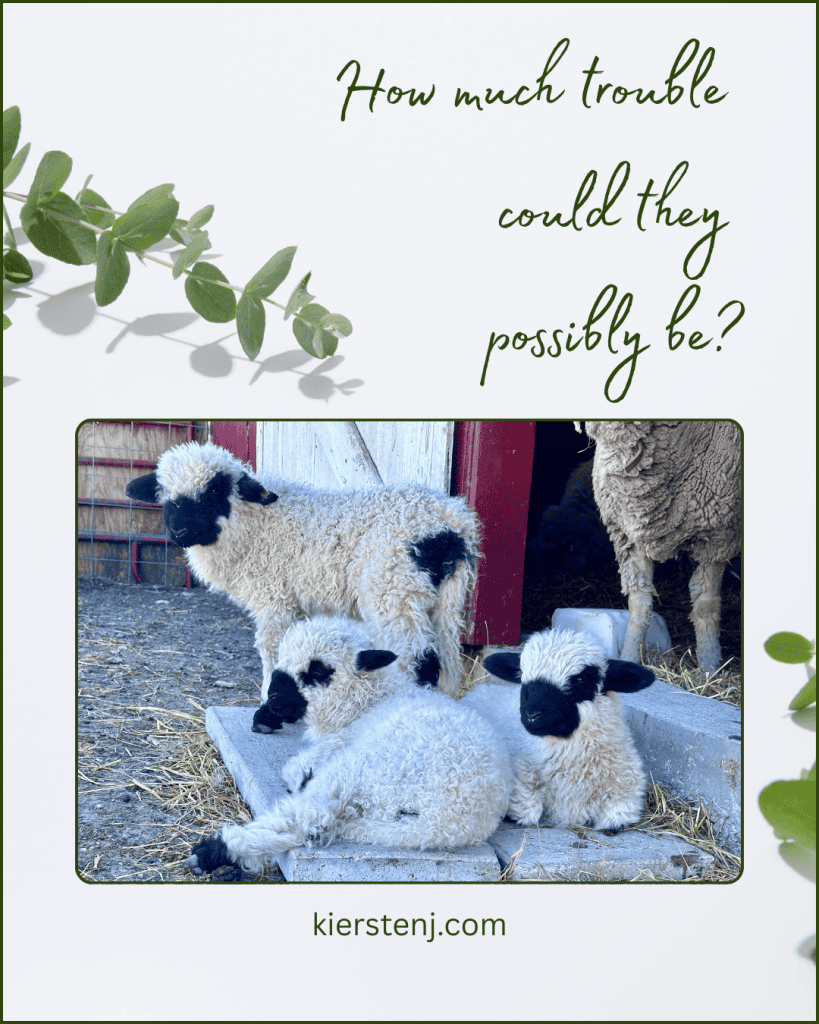
Sometimes I catch myself wondering if we should bring a couple lambs and position them near the spinning wheel to encourage people to stop long enough to look at the curriculum. I usually wake up from that daydream when I start wondering about making custom t-shirts for the lambs with their names on them or dealing with the inevitable by-products of live animals.
More often, I think about all the disciplines that are coming into play as we prepare for this adventure, and about which I know very little.
Here’s an example: Think of the last time you went to a trade show, craft fair, or similar sort of event. I’ll bet a lot of the booths or tables had big banners or signs to identify the business or product being sold. There were goodies being given away, business cards, handouts, flyers, and other things that needed to look nice and represent the business well. Like a graphic designer would do.
I am not a graphic designer. I am just barely comfortable with calling myself an artist in the most limited sense, and that mostly because I believe everyone has some creative ability within them and I’ve happily discovered a way to express mine. If you ask me to draw, paint, or sculpt, though, you’re in for a comedy or tragedy, depending on your mindset. Unless you’re a rare soul deeply moved by unproportional stick figures. Then, I’ve got you.
So, graphic design.
Then there’s the magical combination of interior decorating and marketing that is “booth design.” Did you know that’s a whole big serious thing? It intimidates the spank out of me. What height should the hard copies be? Should we have wool samples on the table or under the table? What side of the table should I be on as I work the spinning wheel? (Seriously. Apparently, there’s a right answer.)
And then…dress code. Do we wear on-brand t-shirts? (Do I design those? More graphic design!) How many do we need? Are we eating anything during these days? Wait, that’s on another list.
It’s a little ridiculous.
And so is one other little issue that has had me stalled out for a few weeks.
Really, it shouldn’t have. I know the answer to this one just as clearly as the booth designer experts know how high to hang signage and exactly where the exhibitors should stand. But it hits me in a certain spot. I wonder if you’ll recognize it.
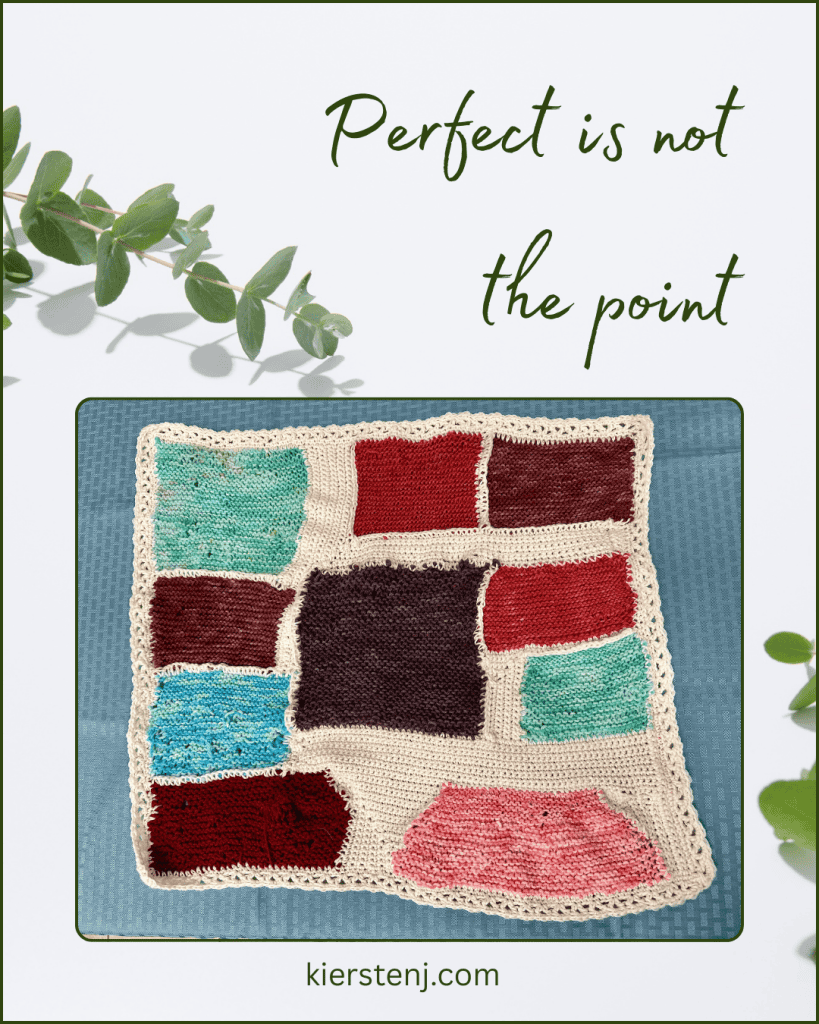
I’m ready to assemble the sample blanket. I have all the squares for it knitted, ready to go, and I have a choice to make. I need to choose whether to make it look “perfect” or “slightly flawed.”
In the actual classes, the squares are delightfully imperfect. Most of them are not squares at all. In fact, several of them don’t even lay flat without some serious persuasion. The finished blanket is charming precisely because all these swatches of first knitting attempts are messy, inconsistent, corporate testimonies of taking on and sticking with a new task to produce something. Together, they are a tangible record of a new adventure.
Well, I can’t reproduce that. I used the same yarn they do, dyed my yarn the way they did, and followed the same instructions, but mine mostly look the same. The only variation in size is when I made myself finish out each skein so that I ran out of yarn before some of the squares were complete.
I don’t have to use the shorter rectangles to make an irregular blanket. I could just use full squares and make it even, symmetrical, and…not right.
Because what am I ultimately trying to share at these conventions?
Another arena for parents, teachers, and students to be stressed about doing things “just right?” Not at all. One of my favorite parts about this class is that it gives students room to fail, and to grow through it, both in skill and in character.
If I mean that, deep down, I need to be okay with my own intentionally imperfect work on display. For days. Blanket and booth.
But probably not the lambs in the matching t-shirts.
Greg’s Got Questions
Thank you to those of you who participated in the poll last week!
This week we had a tie! The winning questions were: Why is Merino wool your favorite wool to spin? AND Of the 18 wool factories now in our flock, who do you think has the best wool and why?
The answers are related, which is nice and tidy.
Merino is probably my favorite to spin because it’s the one I’ve worked with the most. I’m used to it and I love the way it feels in my hands. It’s soft, and I love the quality of the yarn I can make from it.
Right now, our Merino Lizzy has gorgeous fleece on her. I’m really eager to spin hers and Mr. Knightley’s. Emma, or other mature Merino, has nicely crimped wool, too, but she diverted a lot of energy into producing Harriet this year, and less into producing wool.
I have never spun Babydoll wool before, so that will be a fun adventure. The Valais wool is destined for rugs and felting.
I’ll probably be better able to answer the question of whose wool is best after shearing happens this year!
Greg’s Questions for This Week:
Here are the questions up for the vote this week. I’ll answer the winner in the next newsletter. (As a matter of procedure, the poll function takes you to another page to submit your vote, so if that happens to you, you’re on the right track!)
Question 1: What are some of the best ways we can serve the participants of these homeschool conventions while we’re interacting with them?
Question 2: Can you remember and share an example of when you created something far below your typical standard and yet were still very pleased with the outcome?
Question 3: Why did you use the word “probably” in this sentence!? “But probably not the lambs in the matching t-shirts.”
Happy knitting,
Kiersten J